Shaping up
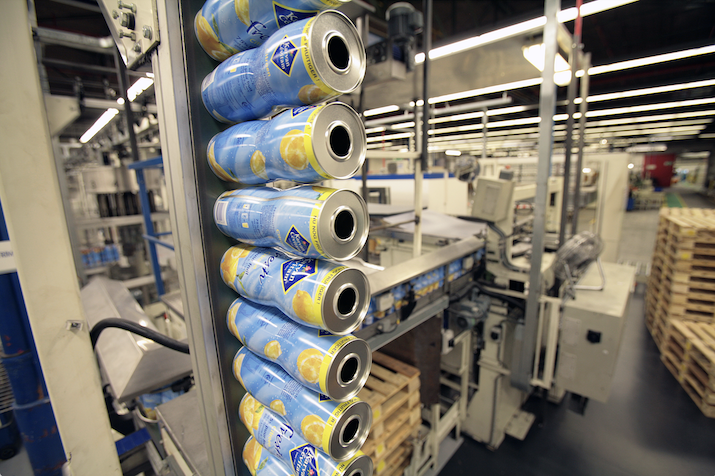
TECSOR high speed shaping line. Image: Andre Journee
Evert van de Weg explores can shaping throughout the course of time, and interviews Hoffmann Neopac and CM Packaging on their practices
Most of us have seen antique pictures proving that the tinsmith has been an important figure for many centuries across Europe. Tin or yellow copper was forged into various shapes of containers. Later on, Britain in particular had a leading position throughout the 19th century in the production of manually, and later on, machine-shaped tins, decorated with an attractive image using a printing press, often in a non-round shape. So you could say can shaping has been around almost since the origin of cans.
Nevertheless, generally when people talk about metal cans, they have round cans in mind. It’s quite logical, because more than 90 per cent of cans globally are indeed round. The round shape, historically, was perfectly functional for many types of food products, so the can making and filling industries focused heavily on optimising the technology to make and fill round cans as economically as possible. There were of course some products that required other shapes, for instance square or rectangular for products such as fish (sardines, mackerel), corned beef, ham and cigars etc).
Van Beuningen in Rotterdam, to publish the book A View on Cans, Design of Dutch Cans. The book was inspired by the birth of the food can in 1810, some 200 years earlier. In the book, we covered the continuous development of design, including shaping, throughout these two centuries for hundreds of cans put on the market by Dutch brand owners, in combination with an exhibition of hundreds of printed and shaped cans. Among our conclusions, we found that the designs of cans often mirror developments in society.
In light of this, CanTech International spoke to Swiss can maker Hoffmann Neopac and Dutch manufacturer CM Packaging, both famous for their shaped cans
On 1 January 2020 Swiss can maker Hoffmann Neopac acquired Dutch can maker CM Packaging. Marketing specialist tins, Paul Pultrum, and Cornelia Schmid, head of marketing, explain the acquisition: “Before the acquisition CM Packaging and Hoffmann Neopac were already longstanding metal packaging partners. Our acquisition as of 1 January 2020 was a logical and strategic move to serve existing customers better, to fill our capacity and punctually invest in new strategic projects and customers.’’
Were Hoffmann and CM Packaging already offering shaped cans to customers?
“We’ve been offering deep drawn shaped cans for many years, especially for the tobacco, confectionery and cosmetics industries. Expanded shaped cans we started to offer some years ago, with a first reference in coffee. Customized and brand-shaped cans give products character and make them unique. Often the shape of a packaging becomes part of the corporate design of a consumer brand.’’
Does Hoffmann/CM Packaging use the traditional methods of shaping cans?
“The traditional way of shaping is mechanical forming, as is done with aerosols and many syrup cans. The more modern way is blow-forming where you use air pressure to ‘press’ the can into a shape. What we will be doing for one of our customers is traditional shaping, but in an exciting and rather revolutionary way. Our proprietary can shaping technology turns cans into unique and imaginative packages. Whether incorporating subtle curves or asymmetrical designs, shaped cans help brands stand out while on the shelf and in consumers’ hands.’’
Which shaped cans would you highlight in particular?
“We would point out the consumer-friendly three-piece can made of tinplate for Nestlé. Nestlé chose a plastic-free lid for its Nescafé Gold Blend Roastery brand. To relieve consumers from the hassle of separating the lid from the body, this is now a full metal pack which is reusable, recyclable and refillable – which has a positive effect on the CO2 footprint of the product when re-used. This golden, deep-drawn, stackable slip-on lid with elegant embossing matches perfectly with the Nescafé tin.’’
Your website makes reference to the advantages of ‘’Tins produced in Europe’’. Can you explain this a little?
“We are located in the heart of Europe and transportation to our customers is fast. So we can react flexibly on demand – as long as we have enough material, which is incredibly scarce at the moment. We also source our material in Europe and therefore act sustainably.”
What innovations in can shaping would you like to mention from the last few years?
“With our latest technical capabilities, we can create digital or offset printing, varnishing and embossing effects according to the specifications of the brand. For example, our latest 3D coating varnish innovation gives cans a special touch and makes it a unique work of art, both visually and to touch. In addition, metal cans are highly suitable for embossing or debossing which are appealing to touch and enhance the packaging value. We can also integrate various security features on the packaging to protect against counterfeiting.”
Are there any new developments foreseen in your company regarding can shaping?
“As a can maker we continue to develop and invest in equipment to meet the needs. Often it is not the eye-catching design that challenges, but rather small special effects that have to be produced in thin walls and at high speeds. This year we will invest in further brand-shaping equipment to fulfil a one-of-a-kind custom design.”
Do you have other new products on the horizon?
“Our latest product is the Green Steel can. The cans are manufactured from a steel canstock supplied by Thyssenkrupp Rasselstein called Bluemint®, which saves 70% of carbon dioxide after hot rolling by using hot briquetted iron (HBI) in the production process. We transport the sheets via train to Switzerland and our production is powered with 100% renewable electricity. The green steel option is a great answer to lower steel packaging’s well-known CO2 intensity. Our customers can heavily reduce their Scope 3 GHG protocol by choosing our tins with reduced carbon intensity.”
Can cans made of Bluemint® steel also be shaped in a normal way?
“Yes, the quality of Green Steel is undifferentiated and can be shaped with deep drawn or three-piece technology. And this is also produced with 100% renewable electricity in our Hoffmann plant in Switzerland.”
TopicsPeopleOrganisationsRegions