Setting industry precedents

Over 7,000 visitors attended Metpack 2026. Image: Alex Muchnik/Messe Essen
A new record has been set for the Metpack international trade fair, which returned to Essen, Germany from 5 to 8 May 2026 after the last edition three years ago. According to show organiser, Messe Essen, the 2026 fair saw over 7,000 visitors, with 350 exhibitors from over 32 countries. Not only does this cement Metpack as a world-leading meeting place for the metal packaging industry, it also highlights the versatile, advanced nature of the industry as a whole.
Candid conversations
New for 2026 was Metpack’s Talk in a Can forum, which took place in Hall 2 and set out to accompany the conference in terms of idea sharing, while offering a more candid structure.
In his opening address, Oliver P Kuhrt, CEO of Messe Essen, said that within metal packaging: “We see an industry that protects, supplies and supports cans all over the world.” Metpack’s role is to see the continuation of this, while “making innovation possible” and “addressing the challenges of tomorrow,” he said.
During the first panel discussion – ‘Opening the Can’ – host Felix Schneider spoke with Mark Smyth, founder of MS Can Solutions; Clarissa Odewald, chairwoman of the executive board at thyssenkrupp Rasselstein; Jörg Hoppner, managing director of the German Metal Packaging Association (Verband Metallverpackungen); Christina Kleinpaß, head of project Metpack; and Gianluca Ciccolini, technical manager of Gruppo ASA and chairman of the Metpack Innovation Awards Jury.
Schneider first discussed Metpack’s ‘Metal Packaging 2026 Outlook’ report with its author, Mark Smyth, who stated that, at the start of 2026, the global metal packaging market was valued at approximately US$155 billion for 2025, representing around a 12 to 13 per cent share of the $1.2 trillion global packaging industry, which makes up one per cent of global GDP.
Of the $155 billion metal packaging share, Smyth noted that approximately 60 per cent represents packaging steel, while aluminium makes up 40 per cent, however, the ever-rising popularity of aluminium beverage cans could see that percentage point rise even further. Later that day, Smyth would discuss the metal packaging report in more detail. (Find out more on our insight on page 58 of this magazine issue.)
Clarissa Odewald noted that even during volatile global events, the demand for metal packaging stays strong. Indeed, the panel repeated Metpack Committee chairman Wolfgang Niemsch’s earlier sentiment that cans are “crisis proof,” as seen during Covid-19, the Ukraine- Russia conflict, Israel Gaza and Iran wars, among others. Smyth noted that of course there will be cost impacts of these events, but certainly not a demand impact.
Hoppner added that the can is also “futureproof” in terms of sustainability too, but that better communication is needed with the public to spread the message – he said everyone should know that “Metal Recycles Forever,” not just the industry that created this phrase.
I then asked the panel how they thought we could best excite consumers worldwide about all the can’s advantages they had already noted. Smyth said that while certainly there is more to be done, French supermarkets in particular are already effective at communicating this with consumers, especially in food aisles. “They promote that you can make all sorts of artisan spreads from canned fish and olives and so on,” he said, adding that consumers should also be educated on the nutritional value of canned goods, which “is unrivalled,” as well as the can’s ability to preserve food.
Odewald stressed that to truly get the message to sink in about metal’s infinite recyclability, we must “explain, explain and explain again. We’re all consumers too outside of work,” she highlighted, so it’s not just about communication up and down the supply chain, and with policymakers and governments, it’s about bringing that down to a personal level also, “telling your friends and family” to spread the message as organically as possible.
“Where the industry has questions, Metpack has the answers,” Kleinpaß concluded, setting the tone for an exciting four days ahead.
Preparing for the future
In Odewald’s opening address at the Metpack Conference, she stated that the metal packaging industry “is in the midst of a structural transformation.” With “several essential shifts unfolding at the same time,” each must be considered by businesses simultaneously, she noted, citing the ever-changeable geopolitical landscape as well as the upcoming regulations set to shape operations worldwide.
She said that one of the most important questions for businesses in metal packaging right now should be “How do we stabilise value creation?” Her answer: in changing times, cooperation and transparency, melded together by increasing digitalisation, will be the key to ensuring industrial performance remains constant, even if global conditions do not.
One trend in the industry only looking to gain further momentum is that of lightweighting. ArcelorMittal’s Laura Rigoni Medeiros, product development manager and Gilles Mangin, senior R&D specialist, said that lightweighting makes up 50 per cent of the company’s partnership projects.
Medeiros explained how the company believes steel forming to be similar to “creating a symphony,” with five key hardening mechanisms involved that must be balanced to ensure optimal material performance. She and Mangin then went on to introduce ArcelorMittal’s Maleïs OpenUp, which made its industry debut at Metpack. Maleïs OpenUp is the company’s range of easy open ends designed for lower opening force from the consumer but still with excellent stability.
Continuing with the topic of steel, thyssenkrupp Rasselstein’s research engineer, Anne Reichardt, and FEA specialist, Benjamin Liebscher, explored how additional downgauging potential in D&I food cans can be unlocked using finite element analysis. Reichardt said the company’s aim is to achieve higher strength without impairing formability, thereby further advancing material savings, efficiency and sustainability. “Material, process and application must be considered together,” Liebscher urged.
Moving onto aluminium, Gus Reall, executive director at CDL, and Dennis Stammen, vice president of metal forming and machinery at Stolle, shared the research they have been carrying out on “converted end technology” under the companies’ joint 1Alloy programme. The 1Alloy idea is that the can, its end and tab can be made of the same alloy; the end goal being that beverage and food cans start as the 3104 alloy, are then melted down in a 3104 state, then re-rolled into 3104. This will eliminate new aluminium and thereby cut up to or just over 90 per cent of the energy needs of the raw material process, Stammen explained.
However, while this solution is economical, it is not sustainable: “we don’t want to heavyweight the container,” said Stammen, as mechanical strength could prove a big issue, and with current end technology, this would result in around a 22 per cent increase in material. He explained that Stolle and CDL have tested the 1Alloy concept with various Stolle tabs: with the X3 tab, a 17 per cent material increase would occur, but with some modifications, Stolle has been able to develop the X4, which could only see a three per cent material increase overall using the 3104 alloy, compared with the 5182 industry standard for ends.
Reall said this concept could be “completely game-changing” for the industry, and so to watch this space for more updates on this research in the near future.
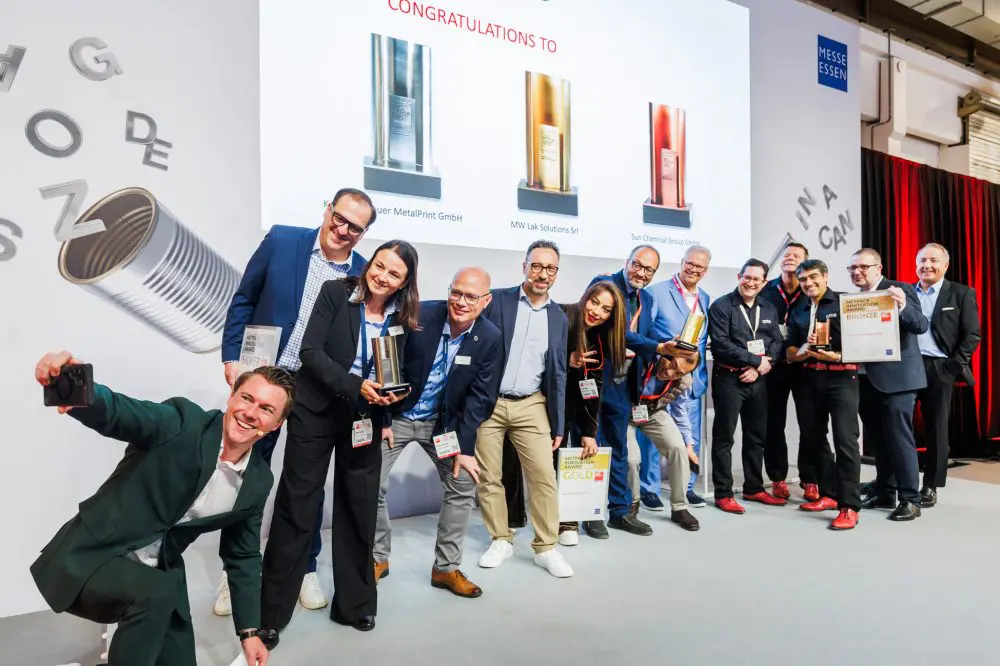
Felix Schneider takes a selfie with the Innovation Awards winners on stage. Image: Armin Huber/Messe Essen
Awards
The Metpack Innovation Awards ceremony, hosted on the afternoon of 6 May 2026, saw jury chairman, Gianluca Ciccolini, detail that a total of 26 entries from 22 exhibitors from China, France, Germany, Italy, the Netherlands, Singapore, Spain, Switzerland, the UK and US were submitted for examination by the international jury. The innovations were evaluated according to criteria such as degree of innovation, sustainability, cost reduction and quality improvement.
MW LAK Solutions Srl received Gold for its UV-LED External White Basecoat for metal packaging; Koenig & Bauer MetalPrint received Silver for its Closed-Loop Inline Coating Thickness Control system; and Bronze went to Sun Chemical Group for an AI-powered colour matching and Direct-to-Can digital proofing solution developed in partnership with CMA Imaging.
Representatives from the three companies were welcomed back on stage after receiving their individual awards for a final celebratory photo and ‘selfie’ with presenter and Talk in a Can moderator, Felix Schneider.
For more detail about the award winners, click here. [Link: https://www.cantechonline.com/news/42517/bronze-silver-and-gold-for-the-future-of-metal-packaging/]
Staying ahead of the curve
As was evident at this year’s trade fair, staying on top of standards and regulations isn’t enough.
Image: Alex Muchnik/Messe Essen
For inks specialist and bronze award winner, Sun Chemical, this attitude involves going ‘beyond compliance,’ as the company’s global business manager for two-piece inks, Shaun Sanderson, told CanTech International. “If something’s on our agenda today, that means it’s going to be a priority tomorrow. And if you can get two problems solved in one hit, why wouldn’t you strive for that?”
CanTech also spoke with Actega’s product manager energy curing coatings and sustainability for metal packaging solutions, Emilie Vedel Blankschon, and global market manager for closures in food, Martha Ochalek on forward-thinking solutions for “next generation” coatings and compounds, based on years of research, development and expertise. While Ochalek said Actega was satisfied with its leadership position in compound solutions, she added that “there’s still a lot of potential” for the company in that area.
Another exhibitor eager to acknowledge and celebrate the past while simultaneously looking ahead was Sencon. Among 50th anniversary celebrations at its stand in Hall 3, the leader in sensors, inspection systems, and gauges introduced visitors to its ES8000XL, the newest addition to the ES8000 Ends Gauging Platform; the Benchmark Flange Thickness Gauge; the SI9200 Semi-Automatic Enamel Rater and the SI9700 Coating Thickness Gauge.
Innosen also launched new products at Metpack in this area: the IS860 CoatPro Coating Thickness Gauge, the IS810 EnamelPro Enamel Rating Gauge and the IS110 Innolytix Data Management Software.
Other solutions for the industry debuted at the show included heat sealed cans from Jorson and EcoCap; Klinghammer’s high-speed stretch forming machine model SFF (Stretch Forming Fast); OEG’s XHM-Pro Cross Hatch Machine for punch surfaces (covered on our equipment page); Re-Lid’s recloseable aluminium lid; Sacmi’s PVCfree annular liner; and many, many more.
For the organisers, Metpack was once again hailed a success: “The strong increase in visitors impressively demonstrates the momentum in this industry and the importance of Metpack as the world’s leading trade fair. It was clear here how companies are developing innovations, strengthening the circular economy, leveraging efficiency potential and advancing digital tools for quality, design and production. Metpack has once again proven that metal packaging is technologically sophisticated, relevant to sustainability and fit for the future,” summarised Messe Essen’s Oliver P Kuhrt after the fair.
Metpack will return in 2029 and will move from Halls 1, 2 and 3 to Halls 5, 6, 7 and 8 at the Messe Essen venue, to accommodate further expansion.
Topics
awards global metal packaging market metal packaging industry metal packaging innovation Metpack 2026 metpack trade fair packaging trade fair
PeopleAnne Reichardt Benjamin Liebscher Christina Kleinpaß Clarissa Odewald Dennis Stammen Emilie Vedel Blankschøn Felix Schneider Gianluca Ciccolini Gilles Mangin Gus Reall Jörg Hoppner Laura Rigoni Medeiros Mark Smyth Martha Ochalek Oliver P Kuhrt Shaun Sanderson Wolfgang Niemsch
Organisationsactega ArcelorMittal CDL German Metal Packaging Association Gruppo ASA innosen Koenig & Bauer MetalPrint messe essen metpack MS Can Solutions MW LAK Solutions Srl Sencon stolle Sun Chemical Group Thyssenkrupp Rasselstein
Regions