
Reducing consumption
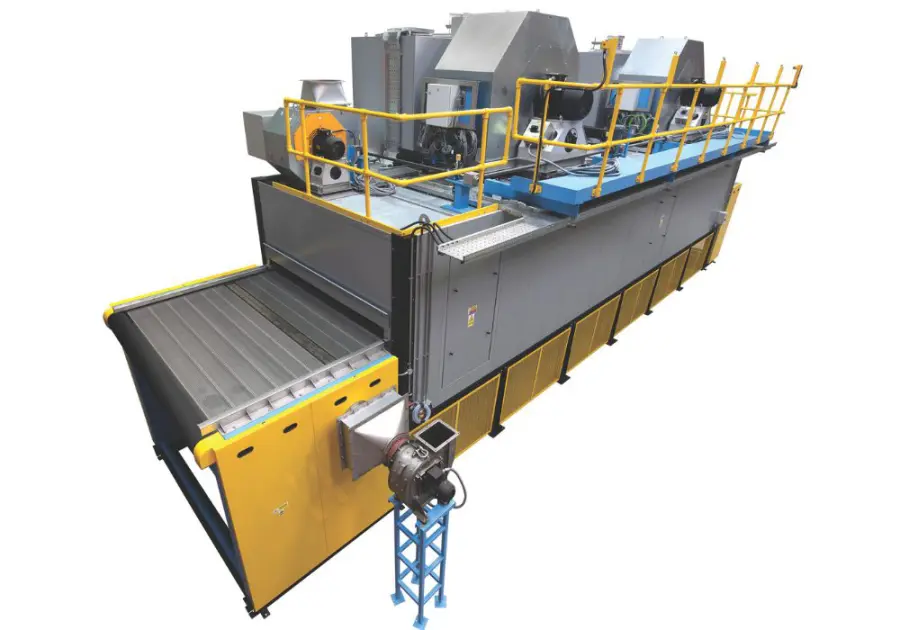
Stolle's Optimus Can Dryer. Image: Stolle
Ovens are an integral part of the can making process, with three distinct types of ovens used on a typical two-piece beverage can line. These large, heated enclosures not only occupy a fairly sizeable piece of the plant’s floor space, they also account for a significant portion of the plant’s total energy usage. However, new technology is being introduced that can reduce an oven’s energy consumption with alternative fuel sources, more efficient heat generation, smart controls and transferring or recycling heat to other systems such as the can washer.
The first oven in a can line, usually called can dryer, receives wet cans from a vacuum transfer unit as they exit the multi-stage washer. The cans are carried on a mesh belt through the dryer where a heat source and fans raise their temperature enough to completely evaporate the water on them in preparation for decorating. Stolle’s Optimus Can Dryer design incorporates a suction-type impingement recirculating air system which allows for a high heat transfer rate, while maintaining can stability via vacuum throughout the heating zone.
The second oven is the pin oven, located immediately after the decorator machine. Stolle’s DecoCure pin oven features next generation high efficiency gas burners that reduce energy consumption over traditional package burners. The ovens achieve a dwell time of under ten seconds due to the uniform heat distribution as well as 150mm thick (100kg/m³) mineral wool insulation in the shell. Direct-driven VFD controls on fans and high efficiency motors help the system to be efficient and responsive. The pin oven currently uses natural gas or LPG.
Located after the inside spray machines, the third oven is the internal bake oven (IBO), which cures the inside protective coating in the cans, and finishes curing the outer inks and over varnish. Stolle’s InterCure IBO has a three-zone configuration that allows for flexibility and latitude with an optional cooling zone if desired. The auto tracking/tensioning synthetic conveyor belt technology eliminates ‘metal fines’ and the oven is available with automatic height adjustment to accommodate all can sizes.
Stolle is reducing the energy consumption of its ovens by utilising hybrid heat source technology. One example of this is Stolle’s Hybrid Can Dryer that can use natural gas, LPG or electric heat sources. According to Andy Raynor, product director of Stolle UK in Burnley, “Typically, dryers are run on natural gas or LPG, and customers have been asking for us to look for alternatives. We’ve come up with a hybrid can dryer that can run gas or electric or both. It’s not only for new dryers, but also for retrofitting existing dryers in the field. One of the major advantages of going electric is that it has no emissions, and if the customer can buy green energy then that boosts the sustainability further.”
Gas power still has its advantages though, which is why the hybrid can dryer is able to heat with gas or electricity, explains Raynor: “The biggest load is when you need to heat the oven up from cold, and the best way to do that is with gas, because it’s quicker, especially when gas is cheaper. But when the load is minimal – when the machine is running – the dryer can switch over to electric.” That switch is done automatically when the oven is up to operating temperature, adds Raynor, further increasing efficiency. While a hybrid heat source is currently available for the can dryer oven, Stolle is exploring other technologies for its pin oven and IBO.
Another way to help reduce an oven’s energy use is with smart controls that monitor the entire can line and adjust heat sources as production requires. Raynor comments: “If the bodymakers stop and the dryer is alerted to this, then the dryer doesn’t need to continue running at temperature – it can switch into standby mode, or even switch off, because we know the timing from when the bodymakers start to when the cans get to the dryer.
“So if the dryer’s smart, it will be able to say: the bodymakers are starting, we’re running at 3,000 cans a minute, take into account the conveyor speed, and calculate the length of time it will take for the cans to reach the dryer, and then begin the process of heating up at the correct moment.”
One consideration when developing new technologies for washers and dry-off systems is to ensure they are retrofittable to the numerous machines already installed in can making plants. Innovations such as Stolle’s heat recovery system for washers have been retrofitted in a number of existing can lines.
“We’ve been selling the system for several years now,” says Raynor.
“We take heat from the RTO (regenerative thermal oxidizer) which processes and cleans the exhaust gases from IBOs and pin ovens, removing VOCs and providing clean exhaust. That clean exhaust is hot, so we put it through a heat exchanger and the heat is transferred back into the washer circuit. Effectively, when the heat recovery system is working, the boilers on the washers are switched off, so it’s basically free energy. This system will eventually expand and we’ll look at additional places we can take heat and use it in the can line or in the building,” he says.
Raynor concludes: “Stolle is continuously looking for ways to reduce the energy consumption of its machines while making them more intelligent and easier to operate and maintain.”
