
Sponsored | Punch Regrinding for Consistent Cans & Longer Tool Life
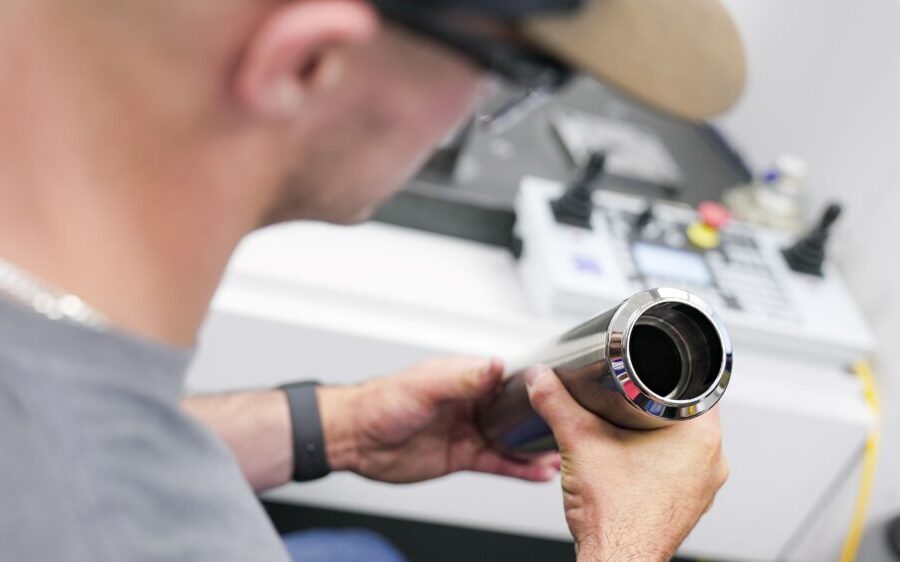
Credit: Hyperion
With the average can line producing more than 3500 cans per minute, tooling is put under significant stress that causes wear. Accurate tooling ensures the line efficiently produces cans within specifications. When tool wear surpasses a certain threshold, can specifications suffer.
While cupper or necker tooling can last years, punches and rings wear much faster. The high wear rate on punch and ring tooling necessitates frequent cleaning and reworking of the components. Managing the wear level of punches is especially crucial to avoid negative consequences in the form of heavier cans, sidewall variation, and unreached axial load.
Proper Maintenance Intervals
By appropriately timing the reworking of punches to measurable parameters, can makers avoid production pitfalls and achieve optimal line performance. The timing of punch regrinding will always be dependent on the working conditions of the specific can line, so the right moment to rework a punch differs across can makers and processes.
While the tool lifespan of a typical punch is about 10-15 million cans produced, the punch material impacts the lifespan. Punches made from Hyperion’s DZ18 carbide grade may last three to four times longer than a punch produced in a standard carbide grade. The material of a specific punch can also impact the recommended regrinding frequency.
Establishing a measurable indicator to prompt reworking of punches for each plant or can line ensures a repeatable procedure to avoid quality issues from excessive punch wear. The Hyperion Can Tooling Team recommends selecting a reworking indicator that is based on a quality issue or specification that is reasonable to measure for the specific line or plant
Direct indicators can be easily tied to the functionality of the punch: wear ratio, can weight, or quantity of cans produced. Alternatively, increases in indirect measurements, like tear off rate or build up, can also indicate punch wear.
Beyond measurable indicators, a physical review of the punch is a simple and effective method for determining if rework is necessary. Worn punches may exhibit damage in the form of scratches, corrosion, and marks. By reviewing for typical wear patterns on punches, canmakers visually identify the right moment for rework.
Proper Regrinding Procedures
Punches can be reworked either in-house or by a trusted outside vendor. In deciding the right approach for punch maintenance, canmakers must balance costs, downtime, and quality of regrinding procedures, so the punch returns to the line functioning properly.
With regrinding facilities in Spain, the United States, and Brazil. Hyperion’s Can Tooling team has global expertise in expertly reworking punches. Hyperion follows these quality-controlled steps to properly regrind a punch for longevity and efficiency.
- Visual Inspection
A visual inspection is critical to avoid unexpected issues when the punch is reworked on the machine. During the mandatory visual inspection, the punch is checked for excessive wear and corrosion. Certain chipped or severely damaged areas make the punch impossible to successfully regrind to specifications.
- Initial Dimensional Inspection
Inspecting the punch dimensionally ensures that the actual geometry of the punch matches the drawing specifications. A thorough dimensional inspection includes step calculation and a CMM features inspection. The step location, profile, rework taper, and nose profiles should be carefully reviewed before the regrinding step.
- Regrinding
As standard practice, almost all outer surface of the punch is reworked, including the major diameter, minor diameter, step, and lower transition. The complexity of the regrinding step depends on the target geometry requirements.
In a standard regrinding scenario, stock is removed in a range of 0.0008-0.0010 inches (0.020-0.025 mm). For punches with significant wear, more material may be removed to achieve a quality finish. Punches could be reworked four to five times if manufactured at maximum size and reworked with standard stock removals. After regrinding, the last operation is polishing where required.
- Final Dimensional Inspection and Certification
A successful regrinding process is confirmed by a dimensional inspection certifying the accuracy of the work. The same critical features reviewed in the initial inspection are again reviewed after regrinding: major and minor diameters, step calculation, step location and profile, and nose profiles.
Conclusion
A proactive maintenance process is a foundational element of increasing the lifespan of punches. Consistent punch regrinding helps can manufacturers avoid heavier cans, can wall thickness variation, and high tear off rates. Punches that are properly reworked at regular intervals perform equally to newly purchased punches.
Hyperion supports canmakers with expert regrinding services in facilities across the globe. Application specialists are available to consult canmakers on implementing a maintenance process suitable to their plant.
