
Getting the right treatment
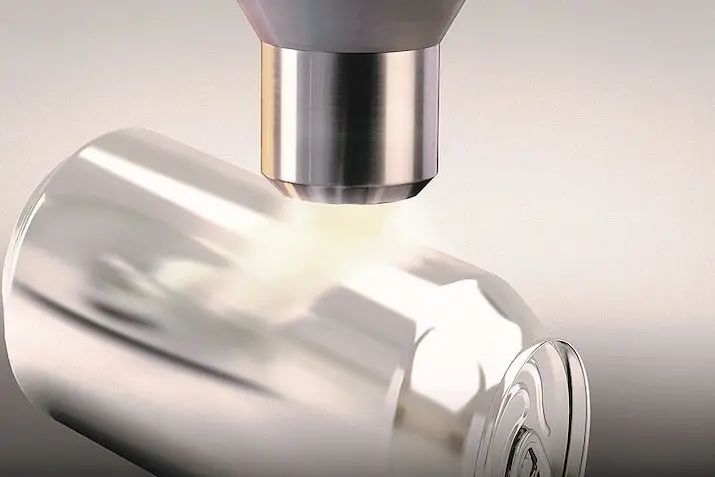
Image: Plasmatreat
Germany-headquarted Plasmatreat made its debut at the Metpack conference in May 2023, showcasing its project with coatings specialist, Actega, and can manufacturer, Brasilata, in Brazil. Here, the company dives into the highlights of its plasma technology for CanTech International
It’s important to carefully prepare the surface of the metal sheet by degreasing and cleaning, to ensure a good adhesion of the inks and uniform distribution of the print. This adhesion, particularly of UV inks, when printing directly on metals or metal sheets, has been a challenge for the industry for many years. In addition to the corrosive effect on the filled product, the quality requirements of the design also imply high demands for subsequent processes, such as deep drawing or trimming.
Plasmatreat has developed its Openair-Plasma technology as a solution, which can be used for food as well as for technical packaging. Plasmatreat’s range includes all flat steel coils or tinplate sheets (Electrolytic Tin Plate, ETP) or chromed steel (tin free steel, TFS).
The high plasma density per square centimetre that Openair-Plasma deposits on the surface cleans thoroughly and removes a large number of oils, rolling oils and lubricants.
Openair-Plasma can clean the surface in a way that the wettability of the applied UV curing varnish is optimum. This way, the varnish also finds its way into the lower areas of the substrate.
Along with the newly developed UV curing varnish from Actega, a permanent bond and an optimum coating/protection to avoid corrosion of the surface is achieved. According to Plasmatreat, no other treatment process is able to achieve this kind of result.
The much stronger direct adhesion offered by Openair-Plasma changes the previous production process: after printing, the metals and sheets no longer need to be heated, drying sections are shortened to approximately 1⁄2 m of the UV curing process, eliminating the need for ovens. In Plasmatreat’s UV direct-to-metal application, during its cooperation with Actega and Brasilata, the need for an approximately 30-metre long oven (powered by natural gas), is eliminated. The plasma system is driven by only (renewable) electricity.
Additionally, since no solvents are required during the plasma process, VOCs and CO2 emissions are minimised; the average VOC content and the amount of VOC emissions are 48 per cent lower for 100kg of wet coating, compared to coatings for thermal curing systems.
The system developed by Plasmatreat for UV printing enables the treatment of sheets with a maximum width at Brasilata of 1,120mm. A total of four different treatment widths can be set.
The treatment speed is faster than any other pre- treatment method, according to Plasmatreat. Under appropriate UV radiation, UV coatings harden in less than one second. In contrast, coatings for thermal curing systems need at least 20 minutes.
For consistently high quality and exact reproducibility of the plasma treatment, the speed, distance of the jet heads to the substrate, and intensity of the plasma beam are precisely adjusted to the surface to be treated.
Determining the optimum parameters, as well as the specially adapted jet heads, are among the core competencies of Plasmatreat, and ensure a reliable pre-treatment. The Plasma Control Unit (PCU) also allows all process parameters to be monitored and controlled in real time. This guarantees a seamless process control and high process reliability.
Aside from its Openair-Plasma technology, Plasmatreat has a special technology – PlasmaPLus – with which it applies an ultra-thin coating layer of 20 nanometres. By adding a chemical precursor into the plasma beam, Plasmatreat is able to create special functional layers on the surface, for instance for corrosion protection, for fog protection, or as an adhesion promotor. It can be used on all kind of surfaces on which an ink can be applied.
