Meeting sustainability challenges

The EU and Switzerland struck a food safety trade deal in December 2024, with European Commission president Ursula von der Leyen and Viola Amherd, president of the Swiss Confederation, meeting in the Swiss capital, Bern. Image: European Commission- Aurore Martignoni
Increasing pressure to meet environmental legislation and achieve sustainability goals is driving Switzerland’s can making and filling industry, Swiss experts have told CanTech International. Executives are also concerned about today’s trading system, with threats to Swiss exports coming notably from US president Donald Trump’s tariffs on steel and aluminium.
Indeed, the Swiss government noted in March 2025 that “an escalating global trade war,” coupled with uncertainty over economic and trade policy, would significantly impact Swiss exports and domestic activity in all areas.
“Trade tariffs, global uncertainty, regulatory pressures and sustainability demands are the biggest challenges facing the Swiss metal and aluminium packaging industry today and in future,” said Tilmann Stein, president of Switzerland’s metal packaging organisation, SVM (Schweizerischer Verband Metallverpackungen). Stein told CanTech that US tariffs have “led Swiss companies to expedite exports to avoid increased costs, highlighting the vulnerability of the Swiss economy to international trade policies.”
Moreover, there are no real government policies in place to support the success and competitiveness of the metal packaging industry, said Stein, adding that the powerful and rich Swiss financial services sector, “does not really” support his industry. “The metal sector is not that important and the industry sector in general makes up only 20 per cent of the Swiss economy,” he noted.
An April 2024 report from national news wire, Swissinfo, stated that, “the Swiss steel industry is facing a serious crisis and significant financial problems, exacerbated by the sharp rise in energy prices,” while the manufacturer Swiss Steel remains in the red.
The head of the SVM said the association helps its members address such challenges by “facilitating connections among member companies for collaboration and knowledge sharing.” He also noted, “sustainability, the circular economy and lightweighting are key trends that will drive innovation in the Swiss can market.”
SVM does not possess Swiss national can production or sales data, but the president told CanTech International that “consumer trends suggest a preference for sustainable and recyclable packaging options.”
Moreover, Switzerland’s Federal Office for the Environment (FOEN) makes clear that aluminium packaging is in demand. “Since the year 2000 [to 2023], the volume in circulation has increased more than fourfold, and this trend continues.” Consumers have collected more than 90% of aluminium drinks cans for many years for recycling, “amounting to 1kg of aluminium cans per person per year,” it said.
Samuel Stämpfli, head of the business unit of Switzerland’s aluminium recycling association IGORA-Genossenschaft [cooperative] für Aluminium-Recycling, also emphasised how important it was for the industry and its customers to meet “evolving environmental legislation,” telling CanTech that this challenge could benefit the sector.
“As Switzerland largely aligns with European policies and global climate targets, companies are required to meet stricter regulations concerning recycling rates, material circularity, carbon emissions and the traceability of used materials,” said Stämpfli.
As a result, Switzerland, which remains outside the European Union (EU) and its related European Economic Area (EEA), is expected to keep pace with demands made in the EU’s December 2024 packaging and packaging waste regulation, in force February 2025, which sets 60% aluminium recycling targets [80% for ferrous metal recycling] for 2030, while EU industry association European Aluminium, (of which IGORA is a member), is aiming for “100% circularity for aluminium beverage cans by 2050.”
Switzerland’s July 2000 Ordinance on Beverage Containers (BCO), which is still in force, prescribes a minimum recycling rate of 75%. If this target is not reached, federal authorities can impose a deposit system. “While these requirements do pose significant compliance challenges, they also represent a unique opportunity.
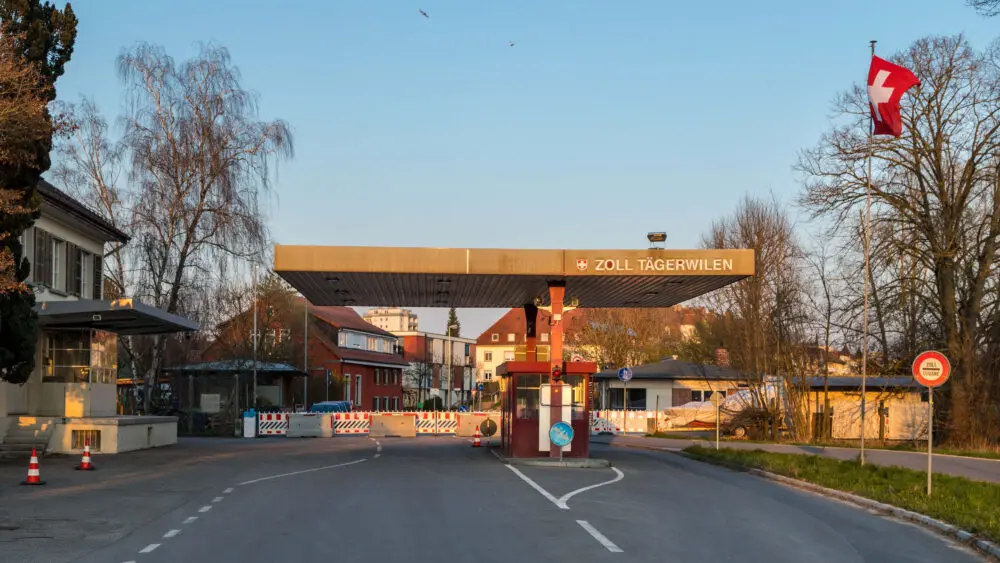
The Swiss German border at Tägerwilen, north of Zurich – here closed because of Covid-19 – will see canned goods move much more smoothly because of the new EU/ Switzerland food trade deal. Image: JoachimKohler-HB
“By investing in more efficient recycling systems and infrastructure, we can significantly improve post-consumer collection and recycling convenience,” Stämpfli argued.
He explained that IGORA, set up in 1989 by companies from the beverage, food, pet food and aluminium industries, as well as a Zurich-based retail cooperative, has developed a “private and voluntary collection and recycling system.”
In practice, IGORA levies a prepaid disposal fee on beverage cans, pet food containers and food product tubes, and it uses the proceeds to pay waste collectors, such as communes and waste processing centres.
The IGORA executive emphasised the “strong potential for innovation in how materials are collected, sorted and reprocessed (re-use), helping us to extend the life cycle of valuable resources such as aluminium.” His association is committed to expanding and developing collection points, making it easy for people to recycle, with “collection convenience a key factor in maintaining participation and efficiency,” said Stämpfli.
The Zurich-based IGORA also strives to raise awareness about the importance of aluminium recycling. This is paying off, given Switzerland’s “consistently high and stable aluminium recycling rate,” he said.
The latest figures from both Metal Packaging Europe and European Aluminium show that Switzerland recycled 91% of its used aluminium beverage cans in 2022, compared to 92% for 2021. The overall 2022 recycling rate for aluminium beverage cans in the EU, UK, Switzerland, Norway and Iceland was 74.6%, a slight drop on the 76% figure for 2021.
To support this high-quality recycling, IGORA “provides financial incentives along the entire collection and processing chain, amounting to [Swiss francs] CHF7 million per year [US$8.52 million] (as of 2024),” the IGORA head commented. Also in 2024, IGORA invested CHF1.3 million ($1.59 million) into marketing and anti littering measures.
Sustainability is also a “major trend driving innovation in aluminium packaging,” seen by the Swiss industry’s commitment to increasing the recycled content in aluminium cans, to improve collection systems and to enhance the efficiency of recycling processes. For Stämpfli, “These efforts are not only about regulatory adherence, but they are also about shaping a more sustainable future for packaging re-use and beverage consumption in Switzerland.” While he does not possess “data driven analysis,” he noted a general trend within Switzerland’s 8.8 million population for beer to be “predominantly consumed in 500ml cans, while energy and lifestyle drinks are typically sold in 250ml cans.”
In addition, a 2023 market report from Euromonitor stated 500ml remains the most popular soft drinks size (for PET and cans), while the 250ml pack size is increasing, driven by consumers’ desire for healthier choices.
Steve Claus, secretary general of Steel for Packaging Europe, also told CanTech that innovation and sustainability was key to the Swiss industry and market, as elsewhere in Europe, highlighting “steady progress on lightweighting and carbon reduction,” and that, “this industry wide approach to innovation is in our DNA.”
This has led to steel being the “most recycled primary packaging material in Europe,” he noted. Independently verified figures published by Steel for Packaging Europe confirm 82% of steel packaging was recycled in 2023 across the continent, with Switzerland’s recycling performance for 2023 exceeding this overall rate with 86%.

Swiss food multi-national Nestlé has been a major player in developing and selling canned food and drink – here, the company’s headquarters in Vevey, Lac Léman. Image: Odrade123
Healthy growth and sustainability concerns are also reflected in other Swiss metal packaged product market data. India-based global management consulting firm, IMARC Group, noted Switzerland’s alcoholic drinks market reached 813.42 million litres in 2024.
“Looking forward, IMARC Group estimates the market to reach 1,142.81 million litres by 2033, exhibiting a CAGR [compound annual growth rate] of 3.5 from 2025-2033,” said a note from the market researcher.
IMARC cites “increasing consumer demand for premium and craft alcoholic beverages, the rising popularity of low-alcohol and non-alcoholic drink options, the growing trend of health-conscious drinking and organic beverages and expanding tourism that boosts demand for local Swiss spirits,” while “innovation in product offerings and packaging attract younger consumers” across Switzerland.
Germany-based global data company, Statista, said the Swiss non-alcoholic drinks market (juices, waters, soft drinks, energy and sports drinks, ready-to-drink tea and coffee) is also expected to expand due to “changing customer preferences for healthier and more natural beverage options… and underlying macroeconomic factors such as a high standard of living and increased disposable income.”
It estimates ‘at-home’ revenue for the total non alcoholic drinks market (bought in supermarkets and convenience stores) will total $3.38 billion in 2025, while out-of-home revenue (for example from restaurants and bars) will be $3.6 billion, making a total revenue of $6.98 billion for 2025.
Given the health of an industry in what remains a very wealthy country ($99,500 average per head GDP – World Bank data), interest in acquisitions is robust. South Carolina, US-based Sonoco’s December 2024 acquisition of leading Swiss metal packaging company, Eviosys, from KPS Capital Partners, reportedly for EU€3.8 billion, is a good example. Sonoco noted that the Zug-headquartered company is “a leading global supplier of metal packaging, producing food cans and ends, aerosol cans, metal closures and promotional packaging.”
With Eviosys generating €2.41 billion’s worth of revenue ($2.81 billion; CHF2.28 billion) in 2023, this was a major sale. For now, SVM’s Stein said there is no available information on its impact on the industry.
Another recent takeover was also noteworthy although a contraction of Swiss metal packaging output. Packaging manufacturer, Hoffmann Neopac, based in Oberdiessbach, 15km from the Swiss capital Bern, sold its can business to French family business, Massilly Group, in February 2025. Metal packaging production at its Gwatt site, near Thun, ceased this year, marking the end of a 135 year era, with the French company continuing to run Hoffmann Neopac’s metal packaging plant in Dronten, the Netherlands. Hoffmann Neopac said it sold up as it wants to focus on its tube business.
Meanwhile, major drinks can players in the country that are continuing operations include non-alcoholic drink market leader Coca-Cola, which started its Swiss operations in 1936, 50 years after the US launch, and Red Bull, which entered the market in 1994.
Some 800 people work at Coca-Cola Switzerland, notably in drinks manufacturing, although Coca Cola Infoline’s Jasmin Kienast told CanTech, “We do not have a can filling facility in Switzerland, as the volumes required locally are too small to justify our own facility,
“This is why cans available in Switzerland are produced in the network of Coca-Cola Hellenic’s filling partner, mainly in Italy,” she said.
International can making major, Ball, has a beverage can making plant in Widnau, near the Austrian border, in operation since 2015. It is close to a Red Bull production site in St Gallen, Switzerland, offering filling opportunities.
Meanwhile, Nestlé, which is one of the largest food and beverage companies in the world and is based in Vevey, in Southwest of Switzerland, has been using cans in some of its popular brands, such as Nescafé (like Nescafé Azera Iced Coffee) and Nestea iced tea for many years. A company statement said it has been using recycled content for products packaged in metal.
TopicsPeople
Jasmin Kienast. Samuel Stämpfli Steve Claus Tilmann Stein
Organisationsball coca cola Coca-Cola Hellenic European Aluminium Eviosys Federal Office for the Environment (FOEN) Hoffmann Neopac IGORA-Genossenschaft für Aluminium-Recycling IMARC Group KPS Capital Partners Massilly Group metal packaging europe nestle red bull sonoco Statista Steel for Packaging Europe SVM (Schweizerischer Verband Metallverpackungen) Swiss Steel Swissinfo World Bank
Regions