Innovating to meet BPA and PFAS rules

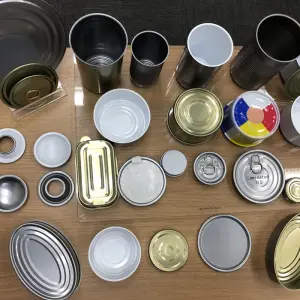
Metal packaging companies have been working with coating suppliers and customers for years to develop alternative coatings for beverage cans. Image: MPMA
European Union (EU) beverage and food packaging manufacturers are facing increased pressure to create safer, more sustainable materials, including internal barrier coatings – the protective linings inside aluminium and steel cans. These linings prevent chemical migration, preserve flavour and protect against corrosion.
One reason is that traditional bisphenol A (BPA)- and per- and polyfluoroalkyl (PFAS)-based epoxies are being regulated out of the European market, notably by the December 2024 European Commission Regulation (EU) 2024/3190, effectively banning BPA and other bisphenols in products coming into contact with food and drink. BPA is used to manufacture certain food contact materials such as epoxy resins for metal food and drink can coatings.
Meanwhile, the EU’s December 2024 Packaging and Packaging Waste Regulation (PPWR), which entered into force in February 2025 and applies from August 2026, includes limits on PFAS in food contact materials and packaging that amount to a ban – for example, 25ppb (parts-per-billion) for any PFAS on an EU list.
Further general PFAS restrictions – following analysis by the Helsinki-based European Chemicals Agency (ECHA) – are expected by the end of 2026, imposed under the EU’s existing REACH chemicals control regulation.
With these regulatory obligations in mind, can makers and coating suppliers are increasingly producing next-generation BPA- and PFAS-free coatings, while aiming to ensure that they provide equivalent long-term performance in corrosion resistance, flavour neutrality and efficiency in high-speed production lines compared to legacy epoxies.
An ECHA note released in February 2026 stressed that BPA is classified in the EU as a substance that is toxic to reproduction; causes serious eye damage; may cause respiratory irritation and skin allergies, as well as being very toxic to aquatic life.
Krassimira Kazashka, CEO of EU rigid metal packaging industry association Metal Packaging Europe (MPE), told CanTech International that MPE members “have been working closely with coating suppliers and customers for several years to develop alternative coating systems and ensure continued regulatory compliance.
“They will be ready to comply with the bisphenol A (BPA) Regulation (EU) 2024/3190 and are committed to delivering product and social benefits through metal packaging,” she said.
One major EU can making company representative (requesting anonymity) agreed, telling CanTech: “Actually, there is nothing specific as far as coatings are concerned to our business or to any other can maker. Our aim is to be 100 per cent compliant with rules and obligations for consumer safety.”
Didier Leroy, technical and regulatory affairs director at CEPE, the European Council of the Paint, Printing Ink and Artists’ Colours Industry, said several innovative technologies have been proposed to replace the ‘universal’ epoxy technology that served all purposes. He pointed out that there are some difficulties for some specific food products, noting: “There is no one fit all solution.”
Continuing, he said: “The PTFE [polytetrafluoroethylene] waxes replacement, together with the replacement of Cr(VI) [chromium VI or hexavalent chromium], is adding to the difficult concomitant changes that metal packagers are facing.”
Turning to regulation, he said that the industry should be able to cope with the BPA (and related bisphenol) ban measure by the 20 July 2026 deadline.
In addition, he said, “in terms of costs, when you have the best cost-effective technology on the market that needs substitution, it always leads to more costs.”
A European Commission official told CanTech the BPA regulation bans the use of BPA to manufacture food contact materials, “in particular its use in packaging such as the coatings used on metal cans,” as well as for consumer articles including water distribution coolers, kitchenware and reusable plastic drinks bottles. “BPA will also be banned in equipment used by the food industry,” she added.
Turning to the question of alternatives, “the Commission is following a pragmatic approach,” the official made clear. “There are very limited exceptions to this ban, in cases where currently no alternatives are available, and which are not considered to pose a risk to consumers. The Commission will keep these under review.”
The regulation also bans the use of other bisphenols or bisphenol derivatives that have been or will be classified with particularly severe hazardous properties at EU level, she said: “These include those classified for reprotoxicity or endocrine disrupting properties.”
Can makers will not have to meet these rules immediately she said, as: “Certain transition periods apply to ensure compliance, allow industry to adjust, and avoid disruption to the food chain,” for example, the 18-month transition period from the PFAS restriction’s entry into force under REACH.
The ban on PFAS in food packaging in the EU packaging regulation, however, will apply when the regulation is applied from August 2026.
BPA has been under the spotlight for years, with furore over its use in baby bottles starting in the early 2000s, leading to a ban in 2011, under Directive 2011/8/EU.
Concern over PFAS, long valued for their ability to repel water, grease and stains, and so making them common in consumer goods including food contact packaging, is more recent.
However, growing scientific evidence has linked PFAS exposure to increased risk of cancer, fertility and developmental issues. In March 2026, Roberto Scazzola, chair of ECHA’s committee for risk assessment (RAC), said the final RAC opinion and evidence made clear PFAS can cause risks to people and environment if not properly controlled: “An EU-wide restriction is, therefore, an effective measure to reduce these risks.”
ECHA’s committee for socio-economic analysis (SEAC)’s opinion adds that PFAS are used in many different applications and so EU-wide action is necessary to avoid trade distortions. In addition, targeted derogations are needed for specific PFAS use when justified by evidence that suitable (ie, not too expensive) alternatives are not available.
An ECHA spokesperson told CanTech its proposal to restrict PFAS substances under EU’s chemical regulation REACH is being finalised, following adoption of the RAC opinion and, when ready, the SEAC opinion.
He told CanTech that further “ECHA’s consultation on the SEAC draft opinion is now over and we received 3,511 comments on it from more than 3,200 organisations and 250 individuals, from 44 countries.
“All relevant submissions will be assessed to confirm or modify SEAC’s conclusions. SEAC is expected to adopt its final opinion by the end of 2026, which will conclude the scientific evaluation of the proposed restriction by ECHA’s committees.
“Based on the two final opinions, in 2027, the Commission will propose a restriction for discussion and vote in the REACH committee, composed of EU member states,” he said.
To meet tougher regulatory restrictions and growing consumer demand, coatings makers worldwide are expanding non-BPA and non- PFAS coatings production. Pennsylvania, US headquartered Sherwin-Williams Packaging Coatings has completed plant expansions at Deeside, west of Chester, UK, and Tournus, eastern France, starting production of its valPure V70 non-BPA beverage can coatings.
“ValPure V70 represents the future of epoxy coatings for light metal packaging,” said Sherwin-Williams in a 2024 note: “It delivers all the performance benefits of an epoxy coating – including superior application performance, excellent flavour retention and industry-leading corrosion resistance – without using BPA.”
In a statement, Ball Packaging noted that in response to stakeholder feedback, it has introduced a new generation of coatings containing no intentionally-added BPA. In addition, as of November 2023, the company’s ‘BPNCA’ (Beverage Packaging North and Central America) region had converted 100 per cent of its coatings to PFAS-free regulatory compliant products.
The company added that to “create more transparency and confidence in the aluminium beverage can,” it is seeking cradle-to-cradle [C2C – multiple uses] material health certification (basic, bronze, silver, gold and platinum levels) for all its coatings. The C2C certification requires product ingredients to be inventoried throughout the supply chain and evaluated for impacts on human and environmental health, said a Ball note.
Some 93 per cent of Ball coatings, inks and compounds used by volume were certified by the USA-based Cradle to Cradle Products Innovation Institute by the end of 2024, with 85 per cent given the silver, gold or platinum rating. The company’s goal is for 100 per cent of its supplied coatings, inks and compounds to be silver level or more by end-2030.