Czech Republic’s major beer sector keeps can manufacturers growing
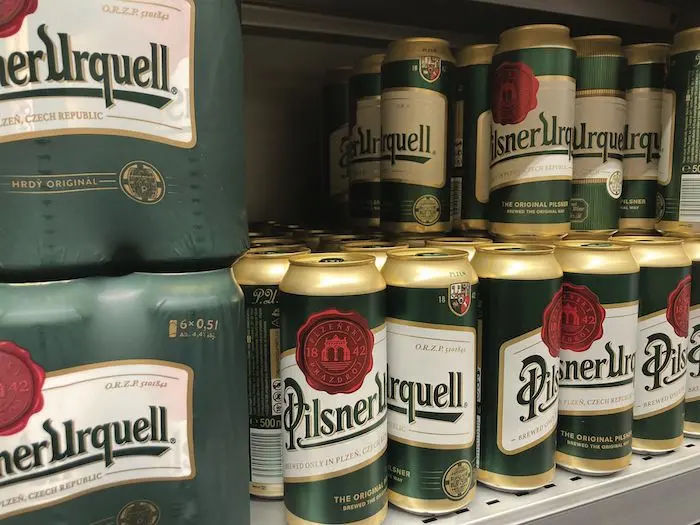
Pilsner Urquell beer owner Plzeňský Prazdroj is one of the founders of the initiative for deposit return system for plastic bottles and cans in the Czech Republic Image: Martina Marečková
Martina Marečková reports from Prague where she discovers that despite outside factors disrupting the metal packaging supply chain, demand for cans remains strong
hen the can manufacturing sector looks at the Czech Republic, there is a big focus on beer. The country, trading on its tasty classic lagers, is a brewing giant. In 2020 the overall production of beer in Czech Republic was 20.1 million hectolitres, of which five million hectolitres were exported, said the Czech Beer and Malt Association (its most recent figures). Its top three export markets are Slovakia, Germany and Poland. And while Covid-19 restrictions have reduced domestic consumption, being 135 litres per capita in 2020 (the lowest level since the 1960s), the Czech Republic usually heads global league tables for beer consumption – and did so in 2020 (1). Home consumption also rose in 2020 and 2021 because of pandemic lockdowns and this has increased canned brand sales. As a result, it is maybe not a surprise that two major international can manufacturers – the USA’s Ball Corporation and Poland-based Canpack – are making major investments in the Czech Republic. Both companies supply aluminium cans to local breweries, important contributors to Czech economy.
Ball already operates a plant near Ejpovice, in the Pilsen region, a major brewing centre, and plans to launch its second Czech plant in early 2023, worth an estimated Czech Crowns Kč4.5 billion (€185 million/$202 million). Its initial annual production capacity will be 1.6 billion cans, according to a Ball statement, which said capacity may double over time.
The new plant will be in an industrial zone near Pilsen city. “The new plant will use the most modern technologies for work that in the past required human power or skill,” Radek Mádr, manager of Ball Beverage Packaging Czech Republic, told CanTech International. However, the company will still be recruiting: “While the company production is to a large extent automated and robotic, we still need skillful people who will mainly handle process parameters adjustment or production process control,” said Mádr.
Ball already managed to hire some highly qualified employees, according to Mádr: “At the beginning of March this year we launched the second recruitment campaign targeting a wider spectrum of positions we plan to off at the new plant,” he said. Ball wants to hire 170 people for the new facility.
Ball will also continue operating the Ejpovice plant where the company last year completed a major investment in expanding production. More than 170 employees currently work there, and the plant’s annual capacity is 1.3 billion cans. Both Czech plants could together have an annual capacity of five billion cans in future, Ball company management told Czech news portal Peak.cz.
Ball supplies aluminium cans to major Czech drinks makers, particularly brewers, exporting an unspecified part of its Czech production. “The ever-increasing demand for canned drinks is a trend we see on all markets including the Czech one,” Mádr noted. “Consumption of beer in cans is growing at double-digit pace in the Czech Republic, and other [canned] drinks sales are registering a similar growth though not so fast,” he told CanTech International.
Ball’s competitor Canpack opened its Czech plant in summer 2020, in Stříbro, also in the Pilsen region. The annual capacity of Canpack facility is about one billion cans. The company invested an estimated €100 million there, it said (2). Canpack’s key Czech client is the Plzeňský Prazdroj brewery whose flagship production facility is only 36 kilometres away from Stříbro. Plzeňský Prazdroj is the largest beer maker in the Czech Republic and the largest exporter of Czech beer, with popular brands such as Pilsner Urquell and Budweiser Budvar. The Ball Corporation supplies the brewer only a small part of its aluminium cans production, however, said Zdeněk Kovář, Plzeňský Prazdroj’s spokesperson.
Aluminium cans are the third most important package in terms of volume sales by Plzeňský Prazdroj, (owned by Japan’s Asahi), following refundable glass bottles and kegs. But can sales are increasing, said Kovář. Consumers appreciate their benefits – they are light, easy to store and easy to cool. And while these benefits have been highlighted by the pandemic and the consequent closures of pubs, bottled beer is still the most important packaging in the Czech beer market (population 10.7 million).
About 46 per cent of beer produced on the Czech market was in 2020 filled in glass bottles, according to the Czech Beer and Malt Association. Kegs accounted for 25 per cent, while tanks comprised 2 per cent, a major decrease due to restaurants and pubs being closed during Covid-19 pandemic, and being re-opened gradually, with restrictions in opening hours and vaccination and negative test requirements for customers, for example. Some 12 per cent of beer was sold in plastic bottles in 2020. Aluminium cans saw a small increase from 12 per cent to 15 per cent of the total beer production in 2020, and for the first three quarters of 2021 it grew to nearly 18 per cent, said the association.
“The share of beer in cans in total production has been steadily growing in the past years,” said Martina Ferencová, Czech Beer and Malt Association executive director. Five years ago, only 6.3 per cent (20,122 hectolitres) of the country’s beer output was in cans.
The main reason for this trend is the changing lifestyle of consumers. “Cans are sought after mainly by younger consumers,” said Dita Vašíčková, spokesperson of Heineken Czech Republic. “Cans are supporting sales of ciders and flavoured beers, which have been growing in popularity in the past decade and which represented a small revolution on the existing conservative [Czech] market,” Vašíčková noted. The overall combined share of kegs and cans of Heineken Czech products is about 50 per cent in 2019 when Heineken Czech produced 2.69 million hectolitres of beer.
The share of beer sold in cans differs from brand to brand. “For example, a majority of the popular ‘cool beer mixes’ are sold in cans,” such as alcohol-free fruit flavour beers – lemon, grapefruit, apple and pear, said Denisa Mylbachrová, spokesperson of Pivovary Staropramen. This company is controlled by the US-Canada based Molson Coors Brewing Co and is the second largest brewer on the Czech market by volume (Heineken is number three).
More than 70 per cent of beer in the Czech Republic is sold in returnable packaging (traditional glass bottles and kegs): “Our brewery copies the market trend,” Mylbachrová noted.
Sustainability is key
Meanwhile, sustainability is also an increasingly important element of the Czech brewing market, with some of the leading drink producers supporting a refundable deposit system for recycling. Number one brewer Plzeňský Prazdroj is a founder of Initiative for Deposit Return System (Iniciativa pro zálohování), for example. This initiative was set up last year (2021) to encourage recycling of empty drink containers through a deposit return system for plastic bottles and cans. The system was also launched this year (2022) in neighbouring Slovakia and Plzeňský Prazdroj was involved in this initiative too. “Returnable packages are key for us because they can be used repeatedly, as it is currently with glass bottles and kegs,” said Plzeňský Prazdroj spokesman Kovář. The share of returnable packaging of the brewer’s drink portfolio is currently around 70 per cent. “We want to focus on beer in kegs because it is the most environmentally friendly type,” he added. Plzeňský Prazdroj at the end of last year (2021) stopped filling beer in plastic bottles.
Heineken is also a founder of Iniciativa pro zálohování, as are leading non-alcoholic drink makers, including Coca-Cola HBC Česko a Slovensko, Kofola ČeskoSlovensko (which sells colas, mineral waters, fruit juices, and more) and Mattoni 1873, (which sells its own mineral water brand and other soft drinks under licence, such as Pepsi, Gatorade and Dr Pepper.
The Czech environment ministry organised in March a debate with drink makers, waste management companies, municipalities and traders about establishing a national deposit return system of plastic bottles and aluminium cans. Nearly 40 experts participated in the debate.
Regardless, recycling is expanding. In 2020, there were more than 73,000 separation bins for metal in the Czech Republic, according to recycling company Eko-Kom. It said that 61 per cent of metal packaging was recycled across the country in 2020. Clearly, there is room for improvement – a survey by Prague’s waste collection company Pražské služby revealed that almost 40 per cent of capital residents throw cans in containers for mixed municipal waste.
While beer can sales are growing, the can market share for soft drinks is stable, accounting for 6 per cent of total volume and 10% for carbonated soft drinks, said the Czech Soft Drinks Association (Svaz výrobců nealkoholických nápojů). “We do not have exact figures because it is the sales strategy of our members,” said Veronika Jakubcová, association managing director. This association as well as the Czech Mineral Water Association (Svaz minerálních vod) support deposit return systems for plastic bottles and cans. And so does Ball Corporation: “We welcome any system which will help increase the percentage of recycling in our country,” said Mádr. Moreover, the metal coils from which Ball produces cans contain up to 80 per cent of recycled content, including material collected by Ball itself, the country’s important automotive industry and consumer recycled cans, Mádr noted. Breweries including Heineken and Pivovary Staropramen said the share of recycled content in their aluminium cans is about 75 per cent. As for Plzeňský Prazdroj, the share of recycled content in its cans is about 50 per cent, but in the case of Pilsner Urquell beer it is 75 per cent, according to spokesman Kovář.
Recycling is a good way to save costs. Companies expect prices of canned food to grow due to the Russian invasion of Ukraine. “We expect significant problems, particularly with supplies of raw materials because the entire steel industry fully depends on supplies of iron ore from Ukraine,” said Roman Weiss, plant manager of steel drums major Greif Czech Republic, based in Ústí nad Labem, north Bohemia. The lack of this material is slated to inflate final prices, he added.
“Aluminium is currently facing a big crisis – aluminium packaging is less available and prices are soaring,” because of the war said Pavel Komůrka, packaging innovation and sustainability coordinator at Orkla, the second largest producer of packaged food in the Czech Republic. “A similar, perhaps even a more dramatic situation, is with metal plate,” he added. Orkla, a Norwegian conglomerate, has operated 10 plants on the Czech market since 2018 (and one in Slovakia), when it bought traditional Czech food producers Hamé and Vitana. In March, Orkla ceased operations in Russia because of the invasion – Hamé had opened a plant there in 2004.
Metal packaging accounts for nearly 20 per cent of all the packaging Orkla Czech Republic and Slovakia buys, being used for prepared meals of the Hamé brand. Czech Orkla brands Znojmia and Otma also use metal packaging made of aluminium and galvanised plate, for example for canned vegetables or tomato paste.
So, while the Czech can industry is disrupted by the invasion of Ukraine, the country’s strength in beer production is likely to ensure the sector keeps expanding.