Canning the perfect blend

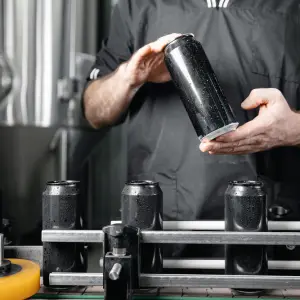
At the heart of the canning line is a new rotary can filler / seamer supplied by Enterprise Tondelli. Image: Storefast Solutions
CanTech International visits local contract packing company, Storefast Solutions, and speaks to managing director, Nick Kirby, about its latest canning line for RTD beverages.
Storefast Solutions began in 1987 when husband and wife, John and Sharon Kirby, founded a warehousing business focusing specifically on foodstuffs, mainly juice. This was imported from around the world and distributed by Storefast to other factories. The business then evolved into working on compounding, which current managing director, Nick Kirby, explained as “the process of blending juice and powdered ingredients or flavours, effectively making a super concentrate that can be ‘plugged’ into the front of a larger manufacturing centre.”
The company moved to the 80,000 square-foot facility now in Northfleet, Kent (ten minutes from CanTech International’s office) in 2008, which is when John and Sharon’s son, Nick, officially joined, (before moving into the managing director position in 2018). He explained to CanTech that the growth in compounding had begun to stagnate somewhat at this time. “Prior to Brexit, a lot of compounding work was undertaken on the continent, so we began looking at alternative ways we could grow the business by diversifying the range of services we offered,” said Kirby.
The final evolution for Storefast was moving into finished pack products, “which initially began in the bag-in-box format,” as this offered a more sustainable solution compared to PET bottles, said Kirby. He continued: “Around this time, we also saw a lot of demand for ready-to-drink (RTD) products, particularly coffee beverages, which we have a speciality in producing.” This was also the time when consumers were beginning to move away from single-use plastic packaging.
Interest in canning
Kirby noted that it was when visiting trade shows such as IFE, BrauBeviale and drinktec that the company began considering options outside of the bag-in-box format. “At the shows, we saw entry level canning equipment that interested us. We knew that supermarkets and retailers were moving toward having more SKUs on their shelves, and a greater variety of products,” he said.
“People didn’t want to have to run 500,000 cans, they wanted to run maybe 30,000 labelled cans, until they’d established themselves more in the market. This led to us making the decision in around 2018 to implement a more versatile solution with the canning line, to help people realise more opportunities in the market.”
Storefast’s first canning line was delivered in 2020, which brought its own challenges amid the Covid-19 pandemic and stalled operations slightly, said Kirby. Once lockdowns had stopped and business was stabilising, however, things brightened. “Originally, we’d bought a craft canning filler, which helped us get established in the market, but we soon learned they are difficult machines to run. We grew a customer base with that initial craft canning filler, and once we had enough custom and could see the market was there, we decided to invest in a larger line.”
This larger line was installed in the summer of 2024 and has extended Storefast’s capacity by five times. The previous canning equipment speed was between 1,500 and 3,000 cans per hour; now, Storefast’s canning line runs at 15,000 cans per hour and can run sizes from 150ml to 500ml, including standard and sleek.

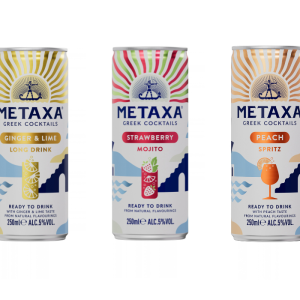
The Drinks Bureau RTD cocktails. Image: Bell Publishing
Equipment & products
“Enterprise Tondelli provided a turnkey solution for us with the new equipment,” said Kirby. The machinery installed includes a rotary can filler/ seamer, an X-ray level inspection/rejection system, a six-zone tunnel pasteuriser with a cooling tower and a Baumer packing system.
The changeover from the old line to the new was completed in three stages, said Kirby, to avoid downtime. “We couldn’t really afford to stop for a period of time because we’d be letting customers down.
“The first phase saw the integration of the new tunnel pasteuriser, where we made sure it was all validated before taking the older machine out. The next piece of equipment to put in was the filler, which initially was installed alongside our other filler as a risk mitigation – we were undertaking the installation in the middle of summer, so didn’t need anything going wrong,” said Kirby, adding that the British summer sees the highest demand for RTD beverages.
“Once we’d seen the new filler working at full capacity with the new tunnel pasteuriser, then we could move away from the old filler.”
The last stage was adding in the automated packing system, which happened in September 2024. “There’s a finite speed at which you can hand pack off the end of the line, so now that we’ve fully automated the process, the difference is phenomenal,” Kirby commented.
In terms of the kind of drinks coming off this new line, Kirby noted that around half are RTD formats. “When brands bring new products to market, they don’t necessarily want to run massive volumes, so a lot of these products will be labelled cans to begin with, before moving on to the printed can format later on when they find success and the demand is enough.”
Other products processed by Storefast are functional drinks spanning across kombucha and energy drinks. “They make up the rest of the volume, as we don’t see demand for many traditional soft drinks at the moment, particularly because we have been dealing in juice for so many years. We’re set up in a way that a lot of other canning companies aren’t, in terms of being able to handle pulpy products and can them correctly.
“We also offer homogenisation services which allows us to access the more premium end of the RTD market, as some of the most successful RTD products have now tapped into this premiumisation.”
Some of Storefast’s customers include supermarket chain, Aldi, which it has produced an Espresso Martini can for with The Drinks Bureau, as well as most recently the Spicy Margarita, which was made available in March 2025. Five new products produced by the company are set to be launched in Aldi stores this year.
Some of Storefast’s products are distributed in Europe however cans are not yet part of this. “We’re finding sufficient demand in the UK market to keep us busy at the moment,” said Kirby.
Sustainability considerations
The Northfleet factory Storefast now operates in was built in 1982, said Kirby, so it was due some upgrades. Last year, the company invested over £1 million instripping out all the factory’s internal panels and replacing them with ones that offer 40 per cent more energy efficiency – something that is highly valued in a business that needs a good temperature-controlled environment for juices in RTD manufacture.
“We also used to have an off-site freezer,” Kirby noted, “so there were a lot of road miles associated with shipping juice back and forth from that.” The solution was to install an on-site freezer at the site.
In addition, and one of the major energysaving moves from Storefast, was to add an acre of solar panels on the factory roof. “We’re probably an optimal user of solar energy, because our RTD demand is highest in summer when we’re running chillers and freezers,” said Kirby. After the solar panel installation, Kirby noted that the company achieved a milestone in July 2024 in that it was only “four per cent reliant on the grid” for its energy during this month.
In terms of the new canning line, Kirby said it is “much more efficient in terms of how much CO2 it consumes. Additionally, wastage on our craft line was typically at about ten per cent, but on our new line is typically sub four per cent.”
Looking ahead
“At the moment, we’ll be pausing on investment while we rationalise some of this new plant. Last year was a fairly busy year for us, so we feel it’s time to take stock and maximise on the opportunity we now have. The last phase of our recent investment has led to a significant period of growth. The business is five times as big as it was eight to ten years ago and we’re hoping for similar growth off the back of this new line,” concluded Kirby.
Topics
business growth canning line Compounding RTD beverages
PeopleJohn Kirby Nick Kirby Sharon Kirby
OrganisationsAldi Enterprise Tondelli Storefast Solutions The Drinks Bureau
Regions