
Manufacturing excellence
A busy exhibition floor provided many networking opportunities
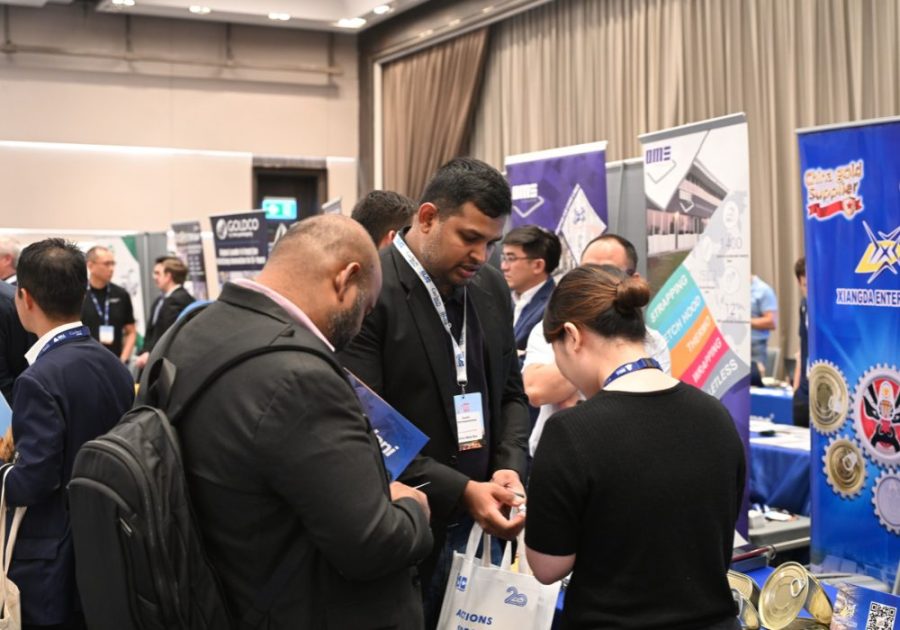
A record number of exhibitors attended Asia CanTech’s 2025 edition, making it the largest tabletop session so far, with 96 companies showcasing their latest developments to over 140 can makers.
Day one saw a bustling setup day followed by a dinner cruise across the Chao Phraya River, setting the scene for an incredible two-day programme.
The conference was opened by Carabao Group’s chief production officer, Kamoldist Smuthkochorn, who explained Carabao’s journey from a world-class band to a leader in energy drinks. In 2001, Carabao Tawandang was established; in 2002, the now iconic Carabao energy drink was launched; and in 2017, the product was finally introduced into cans with the establishment of the Asia Can Manufacturing (ACM) site in Bangpakong, Chachoengsao Province, Thailand, Smuthkochorn said.
He showed the conference audience a breakdown of ACM’s production timeline. After the first 250ml stubby can was introduced in 2018, it reached a production figure of one billion cans in just two years. Subsequent investment followed in downgauging and production of 330ml cans began in 2022, while 2024 saw a huge expansion into more international markets. A US$1.9 million investment in 2024 led to Carabao’s first 500ml can body production, and $4 million has been invested in 2025 in order to commence production of the brand’s sleek 330ml cans.
Smuthkochorn explained that a key part of Carabao’s success in the UK as well as international markets is due to the brand’s title as official sponsor of the English Football League (EFL), which is broadcast to over 200 territories across the globe. Since 2017, viewing figures and advertising revenue have increased exponentially; UK viewing has increased by 60%, global views have increased by 30% and global advertising revenue has gone from GBP£425 million to £1.3 billion. The EFL Cup is now synonymous with the Carabao Cup.
Carabao is not just proud of its football connections; Smuthkochorn explained that sustainability is a key part of its operations across three pillars of technology, environment and community. The group makes all its packaging and packaging materials in-house to remove the need for extra logistics footprint, as well as operating zero waste at all its plants. In addition to its iconic energy drink, Carabao also distils its own spirits and brews its own beer. The Tawandang Brewery, launched as a micropub in Bangkok in 1999, is based on German brewing expertise, Smuthkochorn said, and its beers are the result of collaboration with Versuchs-und Lehranstalt für Brauerei in Berlin. Its three brands include Carabao Beer, Tawandang and Pattaya Beach Beer; the latter was later made available to Asia CanTech attendees during the afternoon exhibition session on 7 October.
To conclude, Smuthkochorn offered Carabao’s latest news, which is its partnership with Chinese beer brand, Tsingtao. A memorandum of understanding was signed on 24 September this year, which is set to bring Tsingtao beer direct to consumers. As well as this, Carabao is working on further partnerships and bringing more of its brands to supermarkets and convenience stores across the globe.
Asia Pacific trends
Many speakers throughout the 2025 conference offered insights into market analysis and trends across the Asia Pacific region. Intralox’s regional sales manager, Sittisant Kanchanawathanont, cited Mordor Intelligence analysis in his presentation when speaking about the growth of the Thai beverage market. The key drivers, he explained, are increasing disposable incomes, urbanisation, and health and sustainability trends, particularly among younger consumers.
He also noted that Thailand’s recycling recovery rate stands at the highest in the Asia Pacific region, at 86%. However, increased demand for lighter weight cans and customisation in print runs, he said, are just two challenging factors for the industry. Transportation on the production line is just as important as off; to ensure less spoilage of cans, Intralox offers deadplate-free transfers with its conveyor belts, which can result in a 70% reduction in can tipping, Kanchanawathanont said. The company has 16 lines operating globally, with
a new line being installed in Southeast Asia in the near future.
Also discussing trends in Asia Pacific, SLAC’s director, Richard Moore, identified China, Japan and Vietnam as the leading countries in terms of beverage can market size. He supported Carabao’s popularity by detailing that growth in Asia Pacific is largely driven by the energy drink segment (after beer and carbonates).
However, despite the global beverage can market growth, Moore admitted that the past two years have been a difficult time for equipment sales, noting that capital expenditure by the leading global can makers fell sharply after 2021. “Virtually no new equipment orders had been received by suppliers to the industry,” he said. During this time, SLAC diversified its market offering and expanded into electric vehicle battery case supply, utilising DWI technology from its can making business for the supply of the battery cases.
Moore noted that equipment order levels from can makers are returning and thankfully are set to grow for 2026. SLAC’s latest developments are underway, which include a new line for aluminium cups and a bottle shaper that will become commercially available in early 2026.
Enpack’s CEO of Europe, Tim Clarke, discussed the “mutual economic interdependence” between China and Europe in his presentation, which he noted “only continues to grow stronger.” Where China has the advantage of scale, efficiency, low labour costs, as well as a focus on robotics and AI, Europe’s focus is primarily on carbon reduction technologies and sustainable innovation. European companies invested €232 billion in China in 2023, and Chinese foreign direct investment in Europe reached €65 billion, Clarke said.
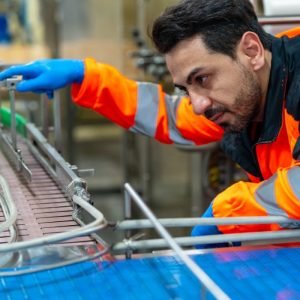
The key to value creation across the supply chain, he said, is based on four framework pillars of manufacturing excellence, managing supply chain risks, navigating regulatory complexity and encouraging innovation partnerships. Communication and digital integration were also both noted as key.
As well as communicating its sustainability practices and achievements in beverage and food ends, Clarke said that Enpack will be focusing on collaboration going forward and encouraged businesses in the audience to follow suit. Twothirds (65%) of Enpack’s business will be driven by partnerships by the year 2030, he concluded.
Future moves
Many of the conference speakers and exhibitors at Asia CanTech 2025 demonstrated that automated processes, cleaner operations and more diverse branding, printing and colour solutions will be the crucial drivers of the metal packaging industry of the future.
Kartonfabrik’s sales director, Christian Breitzing, explained how its automated production efforts now mean that Kartonfabrik can punch four sides of its layer pads in one go as opposed to one at a time as in conventional methods. Additionally, by utilising individually rounded corners, the company is able to optimise workflows and reduce damage to different can size packs during warehousing and transportation. The company is also set to enhance its layer pad traceability in future with the implementation of 2D codes, which can also contain further branding information for the customer, as well as information and warnings about the packaging to handlers, ie ‘keep inside, food grade material,’ etc.
In the area of filtration, Renee Ong, application specialist at Thermo Fisher Scientific, formerly Solventum, explained how the waste disposal of plastics was at the forefront of minds during the research and development process of its 3M High Flow filtration cartridges for can making. Whereas 85 cartridges are traditionally needed for a 30-inch diameter housing, only seven 3M High Flow cartridges are needed for a 24-inch diameter housing, meaning fewer hazardous waste disposal costs for the manufacturer, as well as “by-weight” freight charges.
In can tooling, Hyperion’s director of can tooling, Lluís Miñarro and can tooling design manager, Raúl Pérez, explored standard and premium grade carbide for can tooling punches, introducing Hyperion’s new DZ23 – an evolution of its carbide grade DZ18. In terms of density, the DZ23 is 25% lighter than standard grades, where DZ18 is 15% lighter. Both offer two to four times longer tool life than standard grades, however DZ23 reduces can topwall range variation by 15% compared with DZ18.
Other notable developments shared with the audience included Antares Vision’s new Orion G6 XL for food cans, which extends the company’s 360-degree outside decoration inspection to satisfy the needs of nutritional and health can packaging, as shared by Antares’ regional sales manager for Asia Pacific, Albert Santor.
Innosen’s managing director, Luc Nelen, explored how to master coating control and “make good cans.” He noted that striving for the perfect can isn’t the best course of action, but that with the right equipment and data, good cans will be the baseline. “To have data, you need information,” Nelen said. He explained that Innosen has just released its new Innolytix IS1100, which works on reading data from its enamel rating and coating thickness gauge to create a visual report for quick analysis.
In printing, Koenig & Bauer’s regional sales director, Gerhard Grossmann, noted that his company is celebrating 30 years of its MetalStar metal decorating press. Now in its fourth generation, the press has been a pioneer in can production and has set new benchmarks for the industry.
Marking their debut at the conference, technical project manager, Markus Arnhold, and managing director, Christian Büttner from Roxcel Metal Decoration, explored the innovation behind the sixcolour MR130 machine, a single grip printing press suited to welded three-piece cans and stamped twopiece cans.
Mall//herlan sales manager, Diego Baerlein, shared details of the mall//herlan Prime offset technology. Launched at the beginning of this year, Prime combines the advantages of offset and digital printing, offering more concentrated colour density. This, said Baerlein, means “you’d need a magnifying glass to see the printing pattern with the naked eye.”
In colour, Sun Chemical’s Asia business leader, Lander López, presented the PantoneLive metal deco SunDigiGuide, which is a digitally printed book (very much like a Pantone book) designed to help converters show their brand owner customers the full choice of the spot colours they have at their disposal for aluminium substrates.
López’s presentation also explored how true leaders throughout history have been “rulebreakers” and that the metal packaging industry as a whole needs to be shaped by unique thinking. Throughout the conference, exhibition and awards, it was clear this was a sentiment shared. Indeed, as Prime Controls’ director of sales, Brad Weaver, reminded the conference audience, “the people are what make a company successful.” Those who attended the show this year to share ideas and collaborate could hardly disagree.
Asia CanTech will return to Bangkok from 2 to 4 November 2026.


