
Pacific Tuna Drive
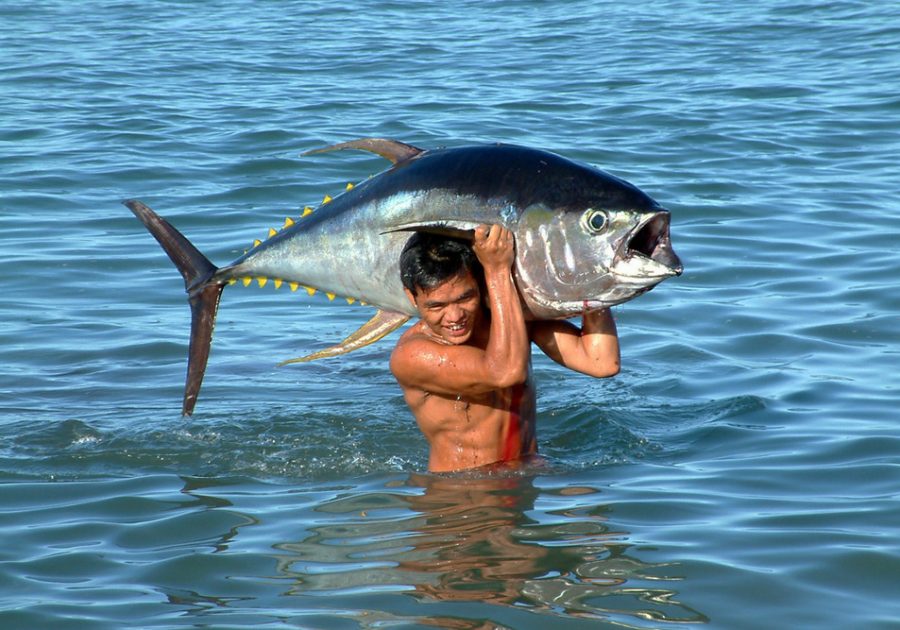
The Philippines is one of the top global tuna producers in the Western and Central Pacific Ocean, with tuna being a top export commodity. Image: Shemlongakit - Creative Commons Attribution-Share Alike 4.0 International licence
Papua New Guinea (PNG) and other Pacific Island states may have plans to increase domestic canning of their natural tuna fishery bounty, but they are having to compete against rival Chinese government goals to expand China’s status as a regional tuna processing hub.
The PNG government announced in May 2025 that it was targeting a reduction of unprocessed tuna exports. It is a major Pacific tuna producer, with annual export receipts exceeding US$700 million, but only 16 per cent of these sales being delivered in cans.
The USA’s International Trade Administration (ITA) has reported that PNG has the largest fisheries zone in the South Pacific – 2.4 million square kilometres – and delivers 14 per cent of the world’s tuna catches.
PNG’s minister for international trade and investment, Richard Naru, announced in February 2026 plans to build ten new tuna processing plants in the island nation, financed by foreign investors.
But there was scepticism within the PNG fishing sector that these projects would deliver: “We do need more factories,” said Sylvester Pokajam, chairman of the Fishing Industry Association in PNG. However, he added, “we need to clarify how these are paid for: the processing plants, wharves and discharge facilities. If we don’t clarify who’ll pay, the foreign investors won’t come.”
Home to some of the world’s richest stocks of tuna, with the Australian government estimating 55 per cent of global tuna output is from the western and central Pacific Ocean, Pacific Island nations rely on revenue from fishing rights to finance their national budgets. But more revenue would come if this tuna were processed within Pacific Island states with major tuna catches, also including Kiribati, Marshall Islands and Fiji.
At present, significant volumes of unprocessed tuna is shipped to processing plants in China, Thailand or Vietnam, with China especially keen to expand processing and canning.
In 2024, according to World Bank data, the top exporters of prepared or preserved tuna, skipjack and bonito were Thailand ($2.4 billion), Ecuador ($1.4 billion), China ($1.05 billion), Spain ($797 million) and the Philippines ($415 million).
California, US-based tuna consultant at Tuna Tech Services and former employee of Starkist Tuna, Don Hosokawa, said goals to expand canning make sense for Pacific and Asian states, given there could be a future global shortage of tuna canning capacity, as demand for this protein increases. US-based market research agency, Grand View Research, projects a 4.2 per cent increase in global canned tuna sales from 2026 to 2033 and predicts the market at $29.9 billion in 2033, up from $21.3 billion in 2025. Hosokawa said wellrun plants are profitable: “A tuna plant return on investment should be 30 to 35 per cent. Payback should be in two years, if you designed and built it properly and you know what you’re doing.”
However, while Hosokawa stressed that investors understand this market expansion for canned tuna and want to sink money into tuna canning, it is questionable as to whether financing can be secured by small island states, with fewer economies of scale and maybe weaker port infrastructure: “Many Pacific Islands are keen to build their own canneries but struggle to access finance and have been reliant on international lending agencies like the World Bank,” he said.
As a result, some experts predict that even plans to build factories in PNG – the most populous Pacific Island state with 11.8 million people – may not be realised. Rather, an expansion in tuna canning capacity is more likely to be built in China, which has also been adding new tuna trawlers to its national fleet. According to the Western and Central Pacific Fisheries Commission (WCPFC), some of these vessels have even been flagged to the PNG and other Pacific Island registries, including the Solomon Islands and Kiribati. Zhoushan, China-based maritime food company, Zhejiang Ocean Family, which has supply deals with both Japan’s Mitsubishi (a major tuna processor and distributor) and popular American tuna brand Bumble Bee, has a fleet of vessels in Kiribati but processes its tuna in China.
A European tuna executive with extensive experience in the Pacific Islands who requested anonymity said China has long-term plans “focused on Shenzhen and a few other Chinese cities becoming tuna hubs [and this is] reflected in large investments in boats, cold storages and processing facilities.”
However, he stressed, these plans do “not include building substantial processing overseas in Pacific Islands, which might be close to the resource, but often lack landmass, water, ports and, importantly in tuna processing, low cost and highly efficient labour.”
For example, the municipal government for China’s Southeastern port city of Xiamen subsidises the transport of tuna from the Pacific back to its harbour, for landing duty-free for processing locally. Shenzhen, the major industrial city near Hong Kong, offers a similar package of tuna shipping subsidies.
“I’ve concluded that all Chinese investment in Pacific Island nations’ tuna sectors will always be focused on obtaining fishing access, the investment being a loss leader to boost the Chinese fleet’s catches, fuel Chinese domestic processing ambitions and secure its strategic long-term access to healthy clean natural protein for its 1.5 billion population,” said the tuna executive.
Another problem is that, despite the growth in demand for tuna and the desire of Pacific and Asian countries to increase canning capacity, under existing conservation controls underpinned by regional fisheries management organisations (RFMOs), such as the WCPFC, official catches are supposed to be limited at around five million tonnes a year. That is according to the representative of a European tuna organisation, who also requested anonymity. He claimed: “Existing processing capacity is more than enough to process the current catch,” so the increase of tuna processing capacity in “certain countries, mainly Asian, will continue to affect prices, but not for good.”
California-based tuna industry veteran Joe Murphy, who has consulted for the Hong Kong–based Luen Thai Holdings, which oversees Chinese fishing companies Liancheng Overseas Fishery, China Southern Fishery Shenzhen Co and Liancheng Overseas Fishery Co, considers the ten new processing plants planned by the PNG as excessive: “I can’t see they are needed,” he said.
Francisco Blaha, a fisheries consultant with 40 years of experience in the Pacific Islands as a fisherman and advisor, explained that Thailand and Vietnam handle significant volumes of Asia/ Pacific tuna processing because they have more competitive cost bases. “China is a relatively new entrant in the purse seine [the large wall of netting deployed around an entire area or school of fish] trawling and canning world and is slowly catching up, taking the space the US, the original power in the canned tuna world, left behind,” he explained.
“The only advantage Pacific Islands have in processing is their proximity to the fishery, yet that alone is not enough to compensate for the disadvantages they face, which stem from two intractable realities of the region: economies of scale and geographical isolation. Very little can be done to compensate for such realities. “The only places where you have canning in the region are PNG and Solomon Islands, which are the biggest islands in the region with good natural ports and human resources, but these are outliers.”
Tuna fishers and traders in the Pacific Islands are hamstrung by high operating costs and low economies of scale, he explained. “Processors face similar challenges due to high electricity costs and limited scope to increase product prices.”
Murphy, like Blaha, believes the Pacific Islands’ remoteness makes them uncompetitive compared to China or Thailand. “PIT [Pacific Island Tuna, based in the Marshall Islands] buys tuna in Majuro [in the Marshall Islands] and ships it to Philippines for processing and then ships the finished goods to the US. It’s doubtful this can be competitive with Thai production. I think China is taking a realistic approach in not promoting processing in the islands. The islands just cannot compete on cost.”
Blaha explains that in some Pacific Island countries, “limited berthing infrastructure is restricting options for vessels to unload and tranship, which can negatively impact opportunities to add value in-country. Cold storage facilities are limited, as are slipways and the maintenance services that would use them.”
Additionally, ports in Pacific Island countries are “generally smaller, less efficient and more costly than their international counterparts,” said Blaha.
Indeed, the Pacific Islands offer little of the services available in Chinese port cities like Shenzhen, a vast manufacturing and logistics hub connected to the world. Blaha added: “There are very few providers of support services like agency services, slipways, repairs and maintenance, refrigeration, engineering and mechanical services for the fishing industry.”
Blaha pointed out that sea freight from Fiji to the EU averages $10,000 per tonne – compared to $2,500 a tonne from Vietnam to the EU. And air freight costs within the region vary widely – from Fiji to the US at $2.07/kg compared to air freight from (better connected and France-run) Tahiti to the US: $0.70/kg.
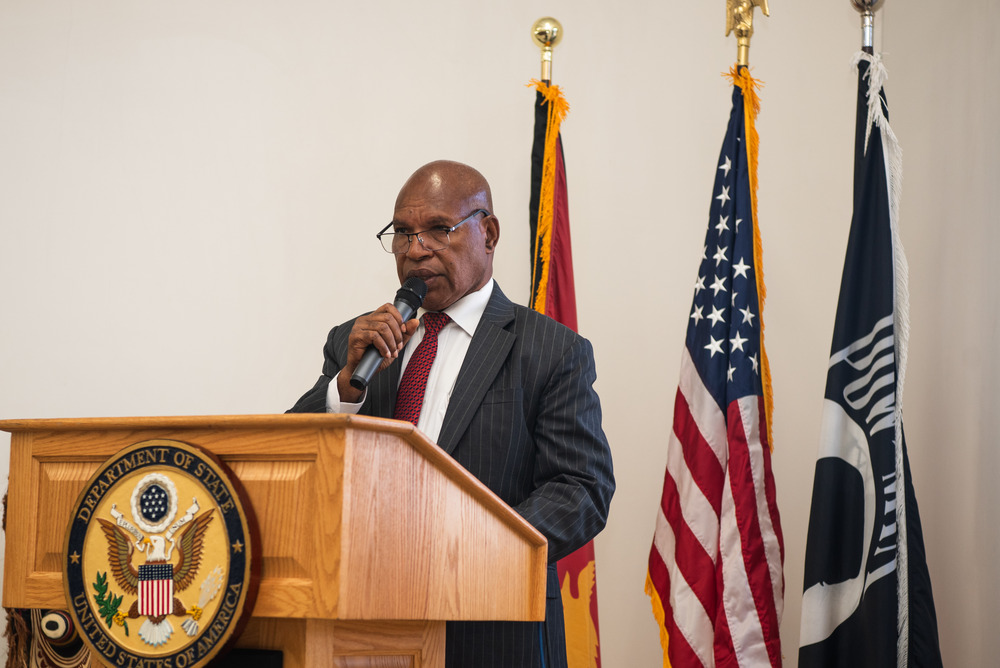
Richard Maru, Papua New Guinea’s Minister for International Trade and Investment, recently announced that ten new tuna processing plants would be built by foreign investors. Image: US Army photo by Staff Sgt. Austin Boucher
Moreover, there is another source of competition for the Pacific Islands over tuna canning – Latin American processing and canning capacity is competing with PNG for duty free access to the important EU market.
Ecuador exported $1.8 billion worth of tuna in 2025, up 14.4 per cent in value terms and up 12 per cent in volume terms, according to the Camara Maritima del Ecuador (the Maritime Chamber of Ecuador), with 63 per cent of Ecuador’s shipments going to the EU, despite EU concerns about its government failing to control illegal, unreported and unregulated (IUU) fishing.
Nonetheless, even faced with all these challenges, Joe Murphy sees a future – a more niche future – for the Pacific Islands in the global canned tuna trade. “I do see more marketing vision from the Pacific Islands,” said Murphy, who points to a joint venture between Pacific Island Tuna, the Nature Conservancy and the Marshall Islands government. “They have enjoyed success at gaining distribution of canned skipjack tuna at Walmart and have several other large retail targets in their sights.” Also, progress is being made on achieving EU certification for compliance with EU tuna fishing control regulations, beyond PNG, the Solomons and Fiji who currently have these approvals that aid market access, said Murphy.
TopicsPeople
Don Hosokawa Francisco Blaha Joe Murphy Mark Godfrey Richard Naru Sylvester Pokajam
OrganisationsRegions