Striving for perfection

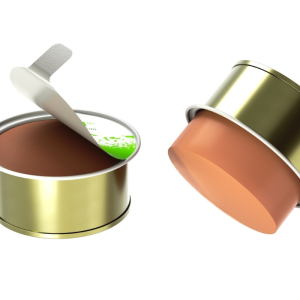
Sonoco’s CapOnCan was unveiled at this year’s Interpack trade fair in Düsseldorf. Image: Sonoco
For an object so finely honed over two centuries, it’s hard to imagine how engineers can improve the three-piece can any further. That isn’t stopping them from trying.
Can makers and their equipment manufacturers alike are looking at a range of technologies to enhance not only the performance of the can but also to streamline the ways in which they are produced. From resealability and sustainability to improved construction, more effective manufacturing processes and lightweighting, the can making industry is far from finished trying to better the three-piece can.
“We will not be able to make any more big changes to the three-piece can itself – that’s a product that has been around 200 years,” Rolf Geide, chief executive of turnkey equipment manufacturer Soudronic, told CanTech International.
“We have downgauged, made smaller seams, used different beads, made improvements in the materials, developed high-speed production… everything.
“The key component we are looking at today is performance,” he said.
Switzerland-based Soudronic makes machinery for almost every part of the three-piece can making line, from slitters to seamers and including transfer systems, but its core business is in seam welding. And in this respect that Soudronic is forging ahead with new ideas.
Keep things simple
Simplification is the watchword for Soudronic as the company makes its welding equipment more user-friendly and reliable.
Its latest range of can body seam welders, the Soucan, can accommodate high-speed production lines of up to 900 cans per minute. These machines have rolling speeds of 450 metres per minute (m/ min) and welding speeds of as much as 140m/min.
To the passive observer, the changes made might look minimal, but it’s under the bonnet that the innovations have happened. Soudronic has reconfigured the geometry of its machines and substantially reduced the number of moving parts in its welders to make them work more efficiently and to make them easier to access for maintenance.
The lengths of wires that pull and drive the welding components have been shortened and the latest technology in drive systems has been applied. Roller heads have been redesigned for higher performance and to make them easier to access and replace.
The latter development is an important one for can makers more generally. When parts need replacing or, on the rare occasions that they fail, the speed at which components can be replaced is critical. Doing so requires the shutdown of the entire line and that means lost revenue for the manufacturer.
With easier access and fewer parts to service, operators can complete their maintenance tasks quicker and reduce downtime.
“Less maintenance, higher control of certain process parameters, quality control products that check the quality of each weld of each can – that’s the basis of the new products,” Geide said.
“We want to have skilled people on the machines, but making changeovers easier – even starting from the cleaning, changeovers, setup, adjustments, quality control – is something we try to apply to the machines today, whether it’s high-speed, 900 to 1,000 cans a minute or whether you then go down to just 80 cans, we apply the same strategy of operator user-friendliness.”
Early warning system
For the same reason, Soudronic has integrated remote monitoring of components through digitally interconnected sensors to give early indications of wear and when parts will need to be replaced. In this way, replacements can be planned to reduce downtime. For instance, its welders can indicate how many more metres of welding capacity of the roller head is remaining.
Integrating the latest in three-piece can making technology ensures can makers remain competitive and responsive to their customers. American packaging giant Sonoco, which is building its food can capabilities after acquiring European tinplate specialist Eviosys in 2024, is constantly looking for new ways to make cans better.
“Innovation at Sonoco is a mindset,” Seàn Cairns, president, Sonoco Consumer Packaging EMEA/ APAC, told CanTech. “We never accept ‘because it has always been done that way’ as a sufficient answer. We constantly challenge ourselves to improve packaging performance, consumer experience and sustainability outcomes.”
The company is investing in new technology to enhance processing efficiency along its lines and is developing in-house a potentially game-changing resealable can end, which offers the prospect of a solution to a challenge that has dogged food producers for decades.
Energy conservation
Sonoco recently installed high-efficiency oxidiser technology in its metal packaging plants to treat volatile organic compounds that are produced during coating and printing. They also capture heat generated by the equipment and redirect that to other processes throughout the facilities, reducing energy consumption as well as emissions.
These measures also help the manufacturer cut its greenhouse gas emissions, which contributes to regulatory requirements to lower its carbon footprint and help customers cut their overall carbon burden too.
Process automation, new inspection systems and process optimisation technologies have also been installed at its factories, Cairns noted. “We see significant potential in technologies that improve material efficiency, process stability and quality control without compromising food safety or pack performance,” he said.
These principles have found expression in an integrated double seam monitoring technology that oversees seam integrity in real time using machine learning. Sonoco installs the systems at its customers’ plants, enabling them to identify defective cans before they reach filling stations.
“Ultimately it enables brands to focus on what they do best and ensure their packaging is doing their job,” said Cairns.
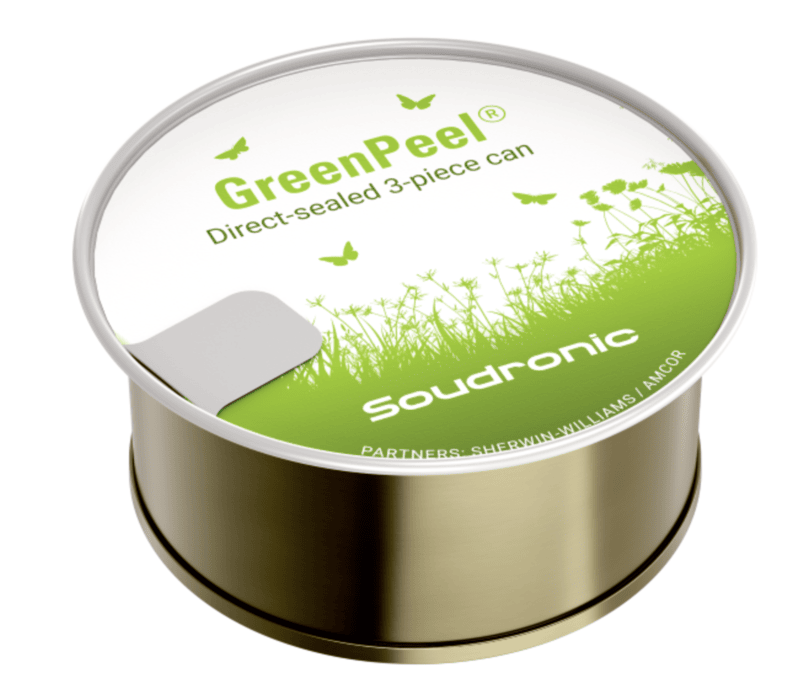
Soudronic has said its recent GreenPeel solution is ideally suited for pet food packaging. Image: Soudronic
While the manufacturer invests in equipment, it also has its own innovation team that is working on a number of projects, including a resealable can end.
CapOnCan is a mono-material resealable air-tight can that has been developed for food that requires thermal processing and retort sterilisation. The cap, which was unveiled at Interpack in Dusseldorf, Germany this year, is fitted using a regular capping machine.
At the product’s unveiling, Sonoco said the CapOnCan was the very first hermetic, resealable can that needs no sealing coating. “The technology is particularly suited to act as a replacement of the duo glass jars plus metal cap system, offering added protection from the light, while lowering weight and corresponding EPR fees, and CO2 emissions in many instances,” said Cairns.
Light metal
Material reduction is a goal of all can manufacturers, enabling them to save on metal costs, waste and CO2 emissions. It seems unlikely that a product so highly engineered can be made any lighter without compromising on strength stability or safety. But Cairns is convinced there is still some way to go.
“We do not believe the industry has reached the absolute limit of lightweighting,” he said. “There are still opportunities to optimise body thickness, ends, overcaps and review overall package design to reduce material use. Advances in manufacturing precision, material science and process control continue to create new possibilities.
“That said, lightweighting must always be balanced against product protection, food safety, filling-line performance, transport resistance and consumer expectations. The objective is not simply to use less material, but to use the right amount of material in the right place.”
In their efforts to shave yet more weight from food cans, both Soudronic and Sonoco have recently designed packaging with light peel-off foil ends that are lighter than traditional converted EOE shells.
Sonoco’s Ecopeel is a three-piece welded tinplate container formed with a flared lip to enables a foil end to be bonded at the top, while a shell end is seamed to the bottom.
Soudronic, on the other hand, has created the equipment to make a weld-free can that is drawn into a cup from a disk of coated tinplate. The bottom is cut off and reformed into an end for the bottom of the can. Branded GreenPeel, the top of the can body is curled to accommodate a peeloff foil that is applied by the can manufacturer, while the bottom end is seamed after filling by the customer. Soudronic said the design, which features no internal edges, is ideal for pet food because it means the food can be easily slid onto a plate or eaten straight from the open can. It also has a seven per cent lower carbon footprint.
Technology is enabling the continued improvement of a product that has been subject to centuries of tweaks as it draws closer to a state of evolutionary perfection. But it’s apparent that the three-piece can is yet to reach a developmental standstill because the can manufacturing eco-system is finding new ways to make incremental changes that improve its performance, affordability and sustainability.
“Innovation starts by asking a simple question: if we were designing this package today, knowing what consumers, brands and regulators expect, would we do it the same way?” said Cairns. “If the answer is no, then it is our responsibility to find a better solution.”