
Ways out of the energy crisis: saving natural gas and considering alternatives

The HighEcon drying oven permits gas savings of up to 70 per cent
Koenig & Bauer MetalPrint outlines possible solutions for saving energy in metal decorating
All images and table information courtesy of Koenig & Bauer
Since the energy crisis, gas consumption has become the focus of attention. Gas prices have risen in almost every region of the world, and are thereby adding significantly to operating costs. Companies are being urged to minimise gas consumption. Many are looking ahead to the winter months with concern and are scanning solutions in the event of a supply shortage. In May 2022, printing press manufacturer Koenig & Bauer MetalPrint presented a Gas Saving Webinar offering possible solutions for thermal dryers to its customers. Here, the company expands on this webinar content for CanTech International readers.
Efficient drying solutions for the metal packaging industry
Koenig & Bauer MetalPrint offers efficient drying ovens for coating and printing lines. Different versions of dryers are installed in the market, with many more than 20 years old. About 70 per cent of the installations have gas-saving potential.
The biggest saving can be realised by upgrading the current installation to a new and efficient system. The extent of this potential is dependent on a number of individual factors, for example whether the line incorporates an exhaust air purification system and which version is installed.
Upgrading your installation
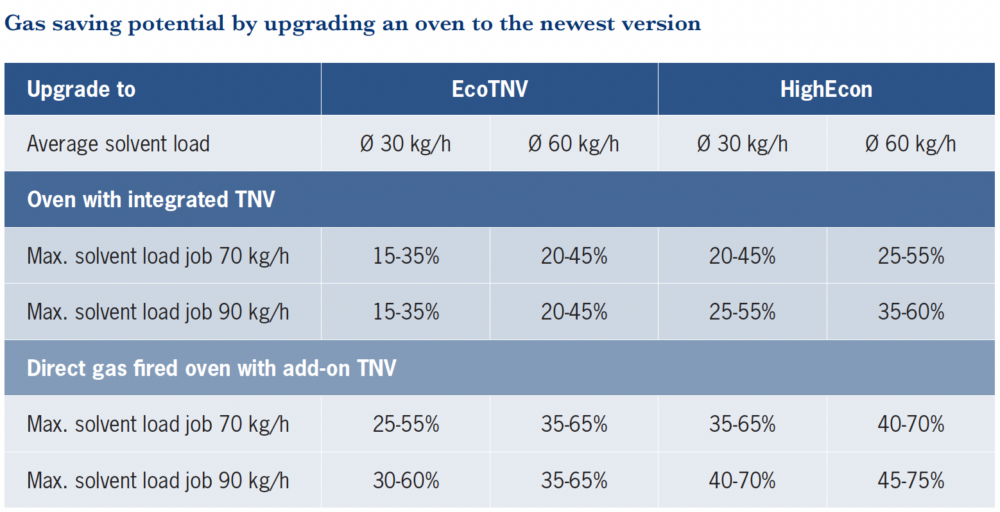
In the case of conventional coating lines using solvent-based lacquers, an integrated air purification system of the latest generation, such as an EcoTNV or HighEcon drying oven, can reduce gas consumption by up to 70 per cent compared to older systems.
If the maximum solvent load has decreased since the installation, an exhaust air reduction can reduce the gas consumption significantly with a relatively small effort. Additional savings can be achieved by measures such as an upgrade to an efficient fresh air heat exchanger.
Koenig & Bauer MetalPrint supports the decision-making with detailed calculations of energy consumption and emissions. The savings potential compared to the current installation will be calculated. The basis is the specific job data, production data and energy prices from customers. The customer then receives a comparative summary of the gas consumption, gas costs and carbon emissions for the installation before and after the upgrade.
Increasing productivity
Further savings can be achieved by increasing productivity and reducing downtime accordingly. The effect refers to installations with integrated exhaust air purification on conventional coating lines. These ovens work particularly efficiently with a continuous solvent concentration in the exhaust air. If downtimes occur, no coating is applied on sheets, the solvent concentration in the air drops and leads to higher gas consumption.
A five per cent increase in productivity can already lead to gas savings of up to 10 per cent. Most companies already organise production in such a way that the same or similar coatings are produced in bundles. This reduces washing times.
Intelligent job management not only helps to increase productivity but also to reduce gas consumption. It is therefore well worth analysing and implementing the final potential.

Upgrades which lead to an increase in productivity, such as a pallet changer at the feeder, should be included in the overall consideration. The pallet changer results in a reduction of the pallet change time from approximately 120 seconds to 20-30 seconds. The higher the production speeds, the greater the effect. A reduction in gas consumption of up to seven per cent can be achieved depending on the initial situation. Furthermore, additional production capacities are created.
It is also possible to factor the influence of additional equipment or measures to raise productivity in the calculation.
Gas savings with direct heated oven
In the case of directly heated ovens, e.g. on printing presses, the gas consumption is always dependent on the necessary heating power. This means that the lighter the sheets, the lower the baking temperature and the lower the production speed, the lower the gas consumption.
Alternatives to natural gas
Where shortages of gas supply are feared, alternatives to natural gas can safeguard production.
There are suitable alternatives to gas that can be used for directly heated ovens and integrated incinerator systems. Unfortunately, these are not always readily available in the required quantity. The first step is therefore to contact local suppliers and clarify which alternative energy source is available.
If an alternative energy source is to be used, the existing installation must be adapted to make it compatible with the properties of the new medium. Depending on the alternative energy source, the change can be a simple upgrade or a larger investment.
Preferred alternatives to natural gas for Koenig & Bauer MetalPrint ovens
Biogas (biomethane)
The composition of biogas can vary significantly.
For use in a Koenig & Bauer MetalPrint drying oven, the following quality is required:
CH4 > 97%
CO2 < 1%
O2 < 0.5%
Unlike natural gas, biogas is considered to be climate-neutral.
LPG (Liquefied Petroleum Gas)
LPG is a mixture of primarily propane and butane, and is liquefied at ambient temperature under pressure totalling > 8 bar. To permit use in Koenig & Bauer MetalPrint drying ovens, either an upgrade must be performed, or an investment in a mixing station is needed to adapt the heat value of the gas to the required level before it is supplied to the oven.
It must be clarified whether the current piping is suitable. As LPG in its gaseous state is heavier than natural gas, a risk assessment must be carried out.
LNG (Liquefied Natural Gas)
LPG is a mixture of primarily propane and butane, and is liquefied at ambient temperature under pressure totalling > 8 bar. To permit use in Koenig & Bauer MetalPrint drying ovens, either an upgrade must be performed, or an investment in a mixing station is needed to adapt the heat value of the gas to the required level before it is supplied to the oven.
It must be clarified whether the current piping is suitable. As LPG in its gaseous state is heavier than natural gas, a risk assessment must be carried out.
LNG (Liquefied Natural Gas)
Liquefied natural gas must be stored at a temperature below -161°C and therefore involves both higher investment outlay for storage and a longer lead time. Once the LNG is evaporated it can be utilised in Koenig & Bauer MetalPrint drying ovens that were designed to be operated with natural gas, without further retrofits. If the calorific value of used natural gas differs strongly from that of gaseous LNG, a Koenig & Bauer MetalPrint oven technician can adjust the oven setup to the new calorific value.
Hydrogen
Hydrogen is the energy source of the future.
The European Union is focusing on hydrogen to achieve climate neutrality by 2050. The hydrogen network is currently being expanded. A focus is being placed on green hydrogen, as it is produced using regenerative energy and is therefore climate-neutral.
The customer must clarify whether hydrogen can be obtained in sufficient quantities in the immediate future. Local availability will vary.
Existing systems require an upgrade to permit the use of hydrogen, and a corresponding risk assessment is also necessary.
UV technologies
A visible trend in printing lines is the use of UV or LED UV technology. Most printing presses are already equipped with UV dryers. They are often supplemented with an inline coating machine that applies a UV protective coating.
For interior and exterior coatings, there is currently no suitable alternative to conventional coatings. There are also still limits for products with special requirements.
Compared to UV technology, LED technology consumes less power. In the area of printing inks, there is already a good selection of LED printing inks. The available range of LED coatings is much smaller than with UV.
If a switch to UV or LED-UV technology is envisaged, a detailed test should be carried out to confirm suitability for each product.

For more information about Koenig & Bauer MetalPrint, contact [email protected]