Why metal packaging has come to a turning point

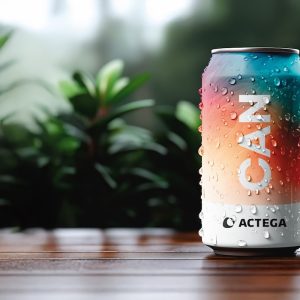
Credit: Actega/Crown
The metal packaging industry is undergoing profound change. Rising energy costs, stricter environmental regulations and growing pressure to cut emissions are creating significant challenges. Beyond binding legislation, this pressure also reflects societal, financial and market expectations, further accelerating the need for transformation. At the same time, demand for stable, efficient processes remains unchanged, as quality, speed and cost-effectiveness are critical to competitiveness. Traditional solvent-based coatings, long the industry standard, are reaching their limits: energy-intensive, emission-heavy and ovens require a lot of space in the factory. In this context, a technology that has so far played only a supplementary role is emerging as a key innovation: UV coatings.
From thermal oven to flash of light
UV coatings differ fundamentally in the process from conventional systems. While conventional coatings cure in thermal ovens and consume a lot of energy (gas), UV coatings cross-link using high-energy UV-light. Two main processes are used for this: UV mercury lamps, which have been established for decades and are reliably suitable for exterior coatings, and UV LED systems, which impress with their even higher energy efficiency. In both cases, photoinitiators in the coating activate polymerisation, causing the coating to cure within seconds. This significantly shortens process times and eliminates the need for large, energy-intensive thermal ovens. One technological advance in recent years is the UV-cured direct-to-metal coating. By pre-treating the surface with plasma, exterior coatings can be applied reliably without the need for conventional primers. This method significantly expands the possible applications of UV technology.
Ecology and economy combined
UV coatings offer both ecological and economic advantages. They reduce emissions of volatile organic compounds (VOCs) to a minimum, as they are formulated to be solvent-free. An Actega and Brasilata calculation shows that this can reduce CO2 emissions along the entire value chain by up to 40%, with reductions of >90% possible at the customer (Brasilata). In addition, energy requirements are significantly reduced as thermal ovens are no longer necessary, and curing takes place within seconds. In practice, savings of up to a third of energy costs are realistic (based on Actega calculation across regions). At the same time, productivity improves: immediate curing shortens production lines, decreases maintenance costs and lowers the emissions. Problems such as uneven drying, smearing or long waiting times hardly ever occur.
Technology in detail
Despite the many advantages, UV coatings also have limitations. They contain photoinitiators, which make them unsuitable for interior coatings with direct food contact. UV-cured direct-to-metal coatings represent progress, but
pretreating the metal substrate with plasma is still required to ensure good wettability and adhesion – in fact, it can deliver better results than conventional solvent-based systems. Nevertheless, none of these technologies is currently suitable for direct food contact. The reason is the photoinitiators needed for cross-linking, which are considered critical in sensitive applications. Future regulations may further restrict their use.
As alternatives, free-curing UV coatings that do not require classic photoinitiators are being developed, as well as electron beam curing (EB), in which cross-linking is activated by electrons. EB systems are efficient and emission-free, but the technology is not that far yet for metal packaging. Both
approaches are considered key technologies for applications involving direct food contact.
Looking to the future
UV coatings address many industry challenges at once: they lower emissions, reduce energy use, enable compact plant designs and ensure high product quality. Even though full implementation in the food sector still requires further technological developments, it is clear that energy-cured coatings – above all UV coatings – have the potential to fundamentally transform the industry. They are more than just an alternative to solvent-based systems and mark the beginning of a new era in which sustainability and high industrial performance go hand-in-hand.