The packaging push

Raw material supply remains an important issue for Saudi's push towards self sufficiency. Image: Zerust
Saudi Arabia’s push to localise manufacturing under Vision 2030 has put metal packaging firmly in the spotlight, with rising food, beverage and tourism consumption driving investment in domestic capacity. Yet widening budget deficits and persistent logistical and raw material constraints are testing how fast – and how far – the sector can grow.
The Saudi metal packaging market is valued at about $1.8 billion at the manufacturing and converting level on an ex-works basis, according to Ken Research, which recently completed a study of the sector.
“Investment momentum in metal packaging is clearly following food and beverage expansion rather than operating independently,” said Namit Goel, managing partner and co-founder of Ken Research. “Over the past two to three years, capital deployment has focused mainly on downstream conversion capacity, particularly aluminium beverage cans and food cans.”
Growth in the sector is being driven by high per capita consumption of non-alcoholic beverages – estimated at 120 to 150 litres per person annually – the expansion of domestic food processing and rising tourism-related demand across hospitality, retail and on-the-go consumption formats.
Massive investments planned by the Saudi government over the next several years under the Vision 2030 initiative are one of the key factors encouraging metal packaging manufacturers to expand their capacities.
“Looking ahead, Saudi Arabia’s favourable demographics, steady population growth and the ambitious Vision 2030 initiatives, particularly the expansion of tourism and food production, present significant opportunities for growth in the food packaging sector,” commented Mohideen Sheik, business development director of the Saudi Can Co. “Metal packaging is expected to remain a critical component of this growth due to its durability, sustainability and product protection advantages,” he emphasised.
Established in 1991 originally to manufacture metal cans for the oil lubricants segment, Saudi Can has undergone a transformation to serve other industries. “Over recent years, the company has made substantial investments in state-of-the-art, fully integrated and automated machinery and equipment. These investments have enabled Saudi Can to transform into a fully diversified three piece tin can manufacturer, supplying a wide range of products to the food industry,” Sheik said.
The transformation reflects broader changes in the Saudi economy, where opportunities beyond oil were limited three decades ago but have expanded as food and beverage production has grown. Today, Saudi Can supplies packaging for olive oil, edible oils, coffee, nuts, oats, halwa, tahina and milk powder, meeting food safety and quality standards, the company said.
Vision 2030 under pressure
Vision 2030 remains the cornerstone of expectations for the metal packaging industry’s long-term growth. However, its implementation is facing mounting fiscal constraints.
Amid a widening budget deficit and lower oil prices, Saudi Arabia announced in December 2025 that it would cut spending and reprioritise large Vision 2030 projects, focusing on initiatives with quicker economic returns.
Saudi fiscal planning relies on a high oil “breakeven” price, often estimated at around $90-$100 per barrel, to fund Vision 2030 spending. Current forecasts place Brent crude prices between $55 and $62 per barrel, raising concerns over the sustainability of large-scale public investment. This has prompted questions over whether projected growth in metal packaging and related industries will fully materialise.
“Oil-linked fiscal risk can affect packaging mainly through second-order channels. When fiscal conditions tighten, the demand effect comes first,” commented Sudip Saha, co-founder of market research firm, Future Market Insights.
Slower consumer spending or a slower hospitality rollout softens beverage and processed food volumes, and metal packaging follows, Saha said, explaining that the financing effect comes next. “Higher funding costs raise hurdle rates and encourage phased line additions. Against this, localisation remains a strategic priority under Vision 2030, so productive industrial capacity tends to be more defensible than discretionary projects. The most likely outcome under stress is slower expansion, not contraction,” he added.
Ken Research’s Goel, in turn, argued that the metal packaging industry is structurally insulated from short-term oil price volatility. “Packaging demand in Saudi Arabia is consumption-led rather than state-capex-led. Food security, FMCG localisation and tourism are protected priorities under Vision 2030, and metal packaging sits directly within these value chains,” he added.
Economic rationale debated
Since the Vision 2030 rollout, quite a few economists have questioned whether the import replacement efforts are justified on purely financial grounds.
A harsh climate, looming water scarcity, a lack of critical raw materials and high operational costs hamper the competitiveness of local production against imports.
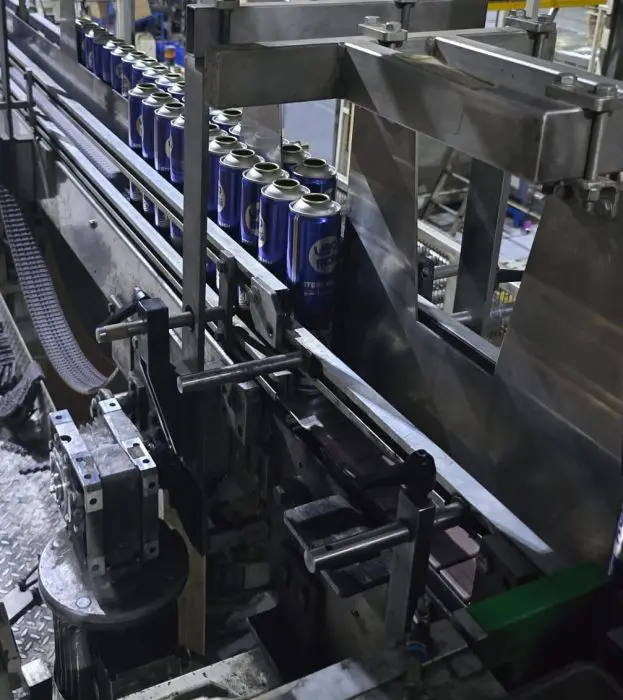
Aerosol cans in production. Image: Saudi Can
“The critique that Saudi will struggle to localise due to raw material gaps, costs, logistics and water scarcity is partly right but often mis-targeted,” Goel said.
The raw material argument is weaker for aluminium, given domestic upstream capability, and more relevant for steel, where tinplate and coatings limit full localisation. Goel continued: “Costs matter, but the logistics disadvantage of empty cans and the value of service levels can make local conversion competitive even without the lowest global cost.”
Water scarcity, he commented, is a real macro constraint that shapes utility pricing, but manufacturing is not among the most water intensive activities, so it is not an automatic veto. “The rational strategy is mixed: localise mainstream, high-throughput formats where logistics and reliability advantages are strong, while importing low-volume variants and specialty specifications where utilisation and qualification economics do not work,” he said.
The concerns related to high operational costs are valid, particularly for upstream metal production, but they are often overstated when applied to the packaging segment. “Saudi Arabia is not pursuing full vertical integration. Instead, it is following a hybrid localisation model, which is economically rational and already proven in practice,” Saha said.
Raw aluminium and tinplate steel are imported, while conversion, forming, printing, and finishing are localised.
“This approach allows Saudi Arabia to reduce dependency on finished packaging imports while avoiding the cost, water, and energy intensity of upstream metal production,” Saha noted.
Fuel in the tanks
Despite the challenges, the Saudi metal packaging industry has a good chance of beating expectations, as companies are showing a willingness to invest.
“Saudi Can remains committed to leveraging its extensive experience and proven expertise in metal packaging,” Sheik said. “The company is currently undertaking substantial investments and product offerings. These initiatives reinforce Saudi Can’s strategic focus on supporting future market growth while continuing to deliver high-quality, innovative metal packaging solutions.”
The outlook for the Saudi’s metal packaging industry is constructive with clear asymmetry between aluminium and steel, Saha said. “In the base case, aluminium beverage cans gain domestic share and gradually displace imports as circularity pressure and recycling capability improve. Steel cans progress more slowly, with selective localisation and continued imports for some formats and specs,” he added.
However, the downside case envisages prolonged oil weakness that slows demand and defers expansion capex. The upside case is faster producer responsibility execution and faster collection buildout, which tightens the domestic aluminium loop and lifts local content. “Overall, Saudi Arabia is positioned to deepen aluminium can localisation meaningfully, while steel localisation remains structurally partial,” Saha added.
Despite headwinds, growth in the metal packaging industry in the coming years will be driven by sustained beverage consumption and premiumisation, expansion of domestic food processing and rapid growth in tourism, with around 27 million international tourist arrivals, alongside a large domestic tourism base.
In addition, policy-driven shift toward recyclable and sustainable packaging formats will also play a role. “That said, success will depend on disciplined capacity planning. Overcapacity risks can emerge if investments move ahead of confirmed offtake. Players closely aligned with large FMCG and beverage customers will be best positioned,” Goel said. “In summary, Saudi Arabia is unlikely to become a global upstream metal producer, but it is well positioned to emerge as a regional hub for metal packaging conversion and value-added manufacturing,” he concluded.
Despite near-term headwinds, industry executives remain cautiously optimistic. Rising beverage consumption, expanding food processing and fast growing tourism continue to underpin demand, while sustainability policies favour recyclable metal formats.
The challenge, analysts say, will be aligning investment timelines with confirmed demand in an environment where fiscal certainty is no longer guaranteed.
Topics
food processing packaging Vision 2030
PeopleMohideen Sheik Namit Goel Sudip Saha
OrganisationsFuture Market Insights Ken Research Saudi Can Co.
Regions