The AI wager
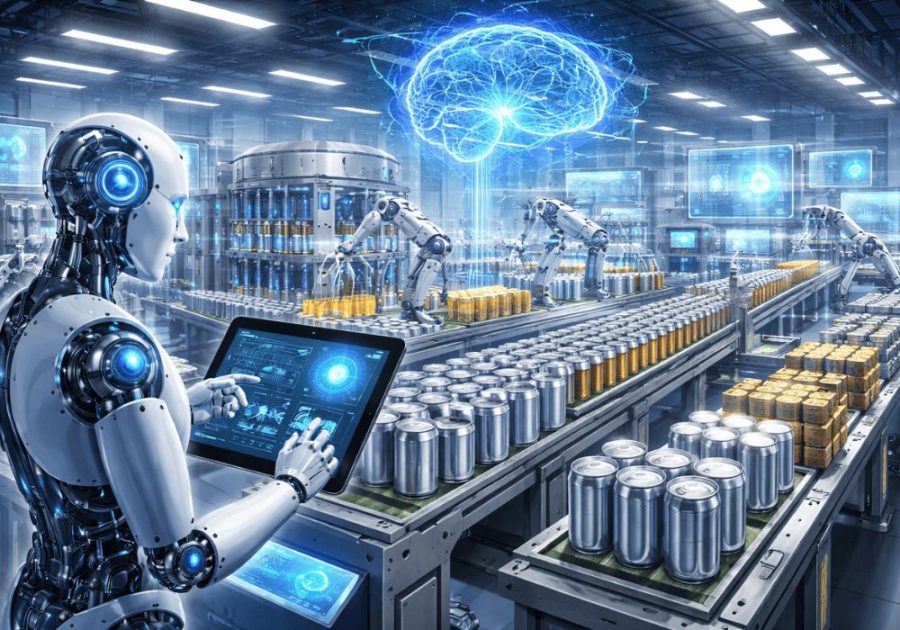
An AI-generated image via ChatGPT of a world where AI plays a key role in the can-making and filling sector. Image: International News Services Ltd/openai
Artificial intelligence (AI) is transforming the aluminium can supply chain, from AI-driven scrap sorting and recycling tools to AI use in rolling, defect detection and can forming, and in smart packaging.
International professional services firm Deloitte’s ‘2026 Manufacturing Industry Outlook’ in November 2025 found that investment in smart manufacturing, such as in automation hardware, data analytics and sensors, all significant in can manufacturing, is “likely to continue” this year. The reason is that AI offers manufacturers a key means “to improve competitiveness, agility, and resilience in the face of uncertainty and complexity,” said the report. Additionally, a survey conducted in 2025 by the USA Manufacturing Leadership Council – a division of the National Association of Manufacturers that helps manufacturers leverage digital transformation – found that manufacturers using agentic AI (AI systems that combine intelligent reasoning with autonomous accomplishment of a specific goal with limited supervision) are expected to increase fourfold in the next two years, from six per cent of surveyed manufacturers in early 2025, to 24 per cent in 2027.
Dimitris Katsikas, co-founder and CEO at D-cube Immersive Solutions, a deep-tech spin-off company, of the Centre for Research & Technology Hellas, in Greece, sees a notable shift in how companies are investing in AI. It does not involve investing only in the technology itself as early adopters but also investing in developing their own AI teams internally: “The maturity level of the industrial partner has changed over the last few years,” he said.
Looking at how AI projects might be rolled out in the can making and filling sector, Katsikas said: “It’s not only about integrating and implementing a technology into a plant, it’s also about how you perceive such a technology and make it your own and start building different things on top of AI.”
Indeed, AI processes are being implemented across the can sector supply chain, from scrap metal sorting where AI-driven automation is improving efficiency, accuracy and sustainability, to machine maintenance.
Italy’s Gefond is one company driving this process, making AI-fuelled predictive maintenance and data intelligence platform Perpetuo, optimising die-casting and foundry operations. Tiziana Tronci, CEO and founder of Gefond, said that to date there are over 150 pieces of equipment connected to its technology.
“In pilot projects and early industrial installations, we have observed measurable benefits typical of predictive maintenance,” she said, “including 35 per cent reduction in unscheduled downtime; 15 per cent extension of equipment life; 16 per cent increase in production; and 20 per cent energy savings,” she said.
In one case, the installation of sensors at a diecasting foundry that suffered frequent hydraulic failures, the software, after six months of machine learning training, began identifying ‘parameter drifts’ when machines perform outside their expected metrics, enabling planned and timely interventions. Tronci said this led, among other benefits, to “248 hours of production time recovered through improved breakdown prevention,” at this client’s production site.
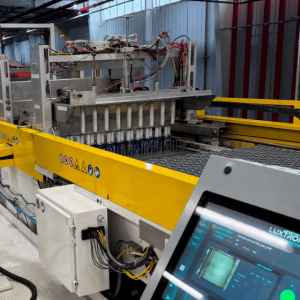
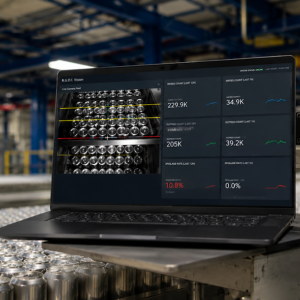
In 2023, Alumil, a Greece-based designer, producer and distributor of high-performance architectural aluminium systems, became the first company worldwide to enhance its production using D-cube’s AI system at its extrusion factory in Greece. Katsikas said this AI-integrated product, called Cyrus, uses a machine vision system inspecting inline aluminium during the extrusion process. He said the system takes “photos in a synchronous way of the moving material, detecting in real time defects on the surface and visualising defects or patterns or meaningful alerts to the operators of the machine.”
On the other side of operations, UK-based digital marketing agency, Appetite Creative, has integrated AI into its connected packaging platform. Jenny Stanley, founder and managing director of Appetite Creative, said that the packaging market, including metal packagers, “has moved decisively from experimentation to strategic investment,” in AI.
That includes using AI-integrated ‘connected packaging’ transforming physical product containers into interactive digital tools using technologies such as QR codes. A 2026 survey for the company showed 81 per cent of respondents using connected packaging as part of an AI super charged brand strategy: “The shift towards AI specifically is being driven by a recognition that the data generated by every scan can be fed back into smarter content, better targeting and more efficient supply chains. Food and drink companies using aluminium cans are especially well-positioned, given the high purchase frequency and the transition to ‘GS1’ QR codes,” which enable a single scan to serve both supply chain logistics such as checkout and consumer engagement, for example product information. This opportunity and understanding “will effectively put connected packaging infrastructure on every product by 2027,” predicted Stanley.
Investment interest in AI applications is not actually driven by the challenges faced by the industries themselves, said D-cube’s Katsikas. It is driven instead by the fear of the management and owners of the industries themselves “that they might lose this AI hype” by being late adapters. In D-cube’s experience, he said, the best projects are those that would take years and years until the outcome and the benefits are realised. “Starting small but thinking big is the best way to approach such a breakthrough technology as AI,” he said.
Jason Galley, chief executive and director of the Metal Packaging Manufacturers Association (MPMA) in the UK, noted that companies are not forthcoming with their AI strategies as they “try and gain a competitive edge,” as they are all still trying to figure out what to do with AI. “Maybe sometimes it’s best to be second rather than first,” he said. Galley pointed out that AI may “give old factories a boost,” improving performance, “as well as putting new equipment in and new technology into new plants and also new product development.”
Gefond’s Tronci pointed out that customers are not simply purchasing equipment when buying AI-related technologies; they are seeking reliability, operational continuity and cost predictability. “The main challenges,” she said, “are not algorithmic, but human and organisational.”
In addition, there is a shortage of specific skills. For this reason, she said: “AI adoption must be accompanied by training, skills development and strong internal engagement.”
Accelerating adoption will require stronger data infrastructures, improved skills development, and practical mechanisms that help companies – especially SMEs – move from experimentation to industrial-scale implementation, said Tronci.
Appetite Creative’s Stanley said that the European Union’s (EU) Digital Product Passport (DPP) system, requiring the digital availability of key data on a product’s origin, materials and sustainability, under the EU Ecodesign for Sustainable Products Regulation (ESPR), (in force from July 2024) is driving European brands towards the kind of transparency and traceability infrastructure that connected packaging is built to deliver. Similarly, Extended Producer Responsibility (EPR) requirements, introduced under legislation such as the EU’s Packaging and Packaging Waste Regulation (PPWR), push producers to track and communicate a product’s full lifecycle — and an AI linked “QR code on an aluminium can is one of the most practical and cost-effective ways to do that.”
Where improvement is needed, said Stanley, is in greater clarity and harmonisation around data governance for the collection by AI systems of mass data on personal preferences. Compliance with the EU general data protection regulation (GDPR) is something her company and its clients take seriously in their commercial and retail communications, she said. “All our experiences are designed with consent-first data collection,” she noted, although she warned that guidance and case law clarifying the interaction between the EU’s 2024 AI Act regulation and packaging-specific use cases is still being defined. “Clearer guidance on low-risk AI applications in consumer marketing would help brands invest with more confidence, rather than pausing for legal review at every step,” Stanley said.
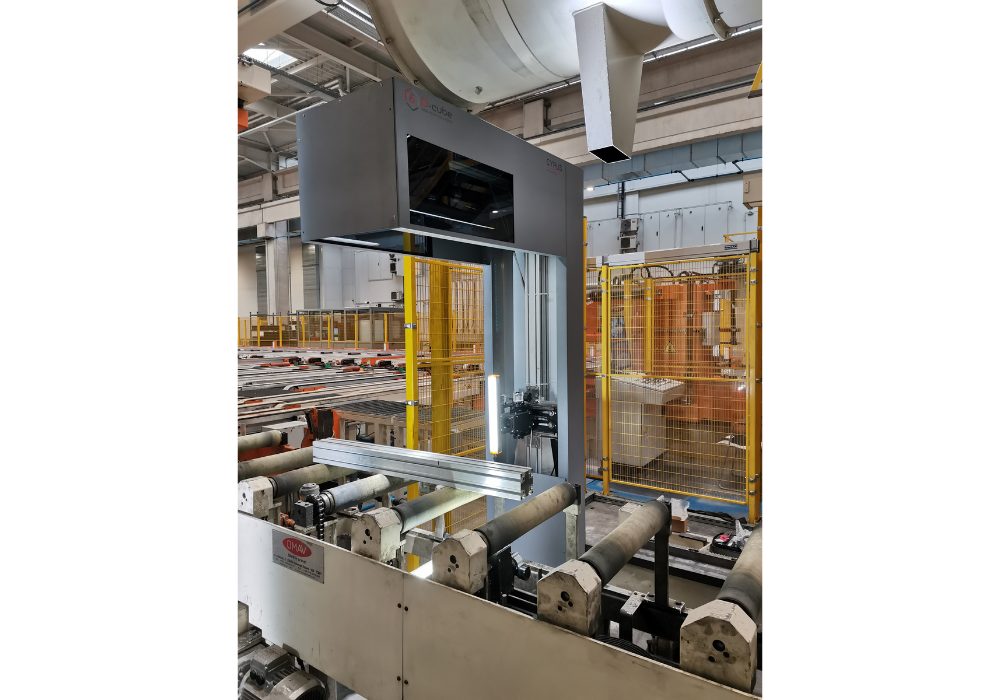
The Cyrus Extrusion with a 4-sensor configuration for all-side inspection on aluminium profiles at ETEM Gestamp Aluminium Extrusions SA (Bulgaria). Image: D-cube
Katsikas too believes that a major AI-linked risk for the can making and filling industry (and others) is related to intellectual property (IP). From the perspective of industrial organisations, the challenge is to be able to build, keep and use “the data generated by AI for transforming into added value services and processes” he said, noting that the EU has built some protections for AI users into regulations such as the AI Act.
Companies also must beware they are not breaching the law’s ethical controls on artificial intelligence. It imposes three risk categories. As per an EU note: “First, applications and systems that create an unacceptable risk, such as government run social scoring of the type used in China, are banned. Second, high-risk applications, such as a CV-scanning tool that ranks job applicants, are subject to specific legal requirements. Lastly, applications not explicitly banned or listed as high risk are largely left unregulated.”
Tronci believes that EU AI-focused legislation is positive in its intent. Indeed, building trust, safety and transparency in AI is essential, particularly for industrial applications: “Within the broader European dialogue on industrial competitiveness and sustainable transition, it is increasingly clear that AI, digitalisation and the circular economy are deeply interconnected and concern the entire manufacturing ecosystem, not just the aluminium sector,” she said. But clearer guidance is needed for low-risk industrial AI applications – such as predictive maintenance and process monitoring with simplified compliance pathways that would help SMEs manage regulatory obligations without disproportionate burdens. “Greater alignment between AI policy and industrial competitiveness objectives would also ensure that regulation fosters innovation while maintaining safety and trust,” argued Tronci.
For MPMA’s Galley, it would also be helpful if there was specific public funding for traditional manufacturing industries to integrate AI in their operations, and if there was a supportive energy policy for UK-based companies, given AI can consume a lot of electricity.
Overall, Stanley concluded: “The circular economy agenda is a genuine opportunity” for AI usage. From her perspective, the EU could go further in actively incentivising connected packaging as a compliance mechanism, “recognising it not just as a marketing tool but as critical infrastructure for recycling guidance, product transparency, and supply chain accountability.”
Topics
AI Automaton in manufacturing digital transformation legislation smart manufacturing
PeopleDimitris Katsikas Jason Galley Jenny Stanley Michael Kosmides Tiziana Tronci
OrganisationsAlumil Appetite Creative D-cube Immersive Solutions Deloitte Gefond Metal Packaging Manufacturers Association
Regions