

Producing high-performance models

The Uniseal HSS-SL Single Lane model is aimed at customers entering the peel-off can market in relatively small quantities
Soudronic expands its three-piece can equipment collection. David Hayes reports.
During the past five years, the global food can industry has seen important changes in can making machinery investment trends. Can manufacturers responded to high demand for food cans during the Covid-19 pandemic peak years from 2020 to 2022 by increasing production volumes to meet an international surge in supermarket canned food sales.
Following the end of the pandemic and a sharp reduction in canned food purchases by families to store at home in case of pandemic-related food shortages, food can demand generally has returned to pre-Covid levels characterised by modest incremental growth rates.
Can manufacturer investments in new production equipment and machinery upgrades have returned to pre-Covid levels after many can makers upgraded and expanded their production facilities to comply with recent changes in the three-piece can market, including compliance with new food can safety and production sustainability regulations.
“Regarding our customer equipment business, we had our best year ever in 2022, then in 2023 and 2024 the food can machinery market went back to its pre-Covid level, and it is still a good market,” commented Rolf Geide, CEO of leading three-piece can making machinery group, Soudronic AG.
Various factors can trigger a customer order for new equipment, including a can manufacturer deciding to expand output by upgrading existing machinery, or by installing a completely new line. “There are a lot of older machines in use in many countries, so we offer our customers machine upgrades and replacements. We offer them a good opportunity to modernise older production lines,” Geide said.
“This has happened for many years in the European Union, for example, where there are new occupational health and safety regulations. Some can makers may have a lot of upgrading to do in their factories.”
Soudronic has introduced a number of new welding machine series developed to meet customer demand for convenient, easy-to-operate equipment.
The Compact 240 welder, for example, is designed to occupy a 2,300mm diameter floor space, a small footprint size that would allow this model to be installed in any existing can production lines. Capable of producing up to 240 cans per minute, this compact machine welds large containers with a side seam on the bottom side, while smaller containers and cans are welded in the traditional seam on top.
Designed with a simplified wire routing numbering less than ten wire pulleys, Soudronic has optimised the Compact 240’s wire consumption by using a precise stop-and-go wire drive system for slow and/or large container production. In the case of a continuous feed of small can bodies, the gap can be set to as little as 1mm.
Another feature of the Compact 240 is Soudronic group member Can Man’s QuickChange system, either automated or manually employed, which enables a can height setting change to be made in five minutes or a complete can format change in less than 20 minutes.
Soudronic supplies welding equipment designed for a wide range of customer production speed requirements. Medium speed welders continue to attract strong interest among the firm’s customers, according to Geide. Orders for medium speed models have remained stable for the past two years and seem likely to remain so for the rest of this year.
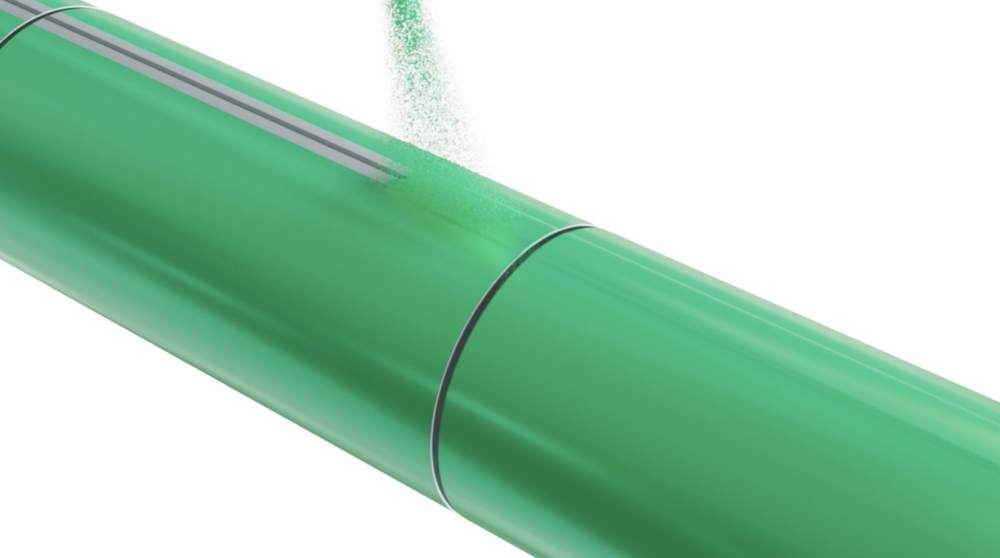
The PowerCoat oP machine uses an application which produces a seam coating the same colour as the main can body
“When customers order only a welding machine then it’s mostly a medium speed machine they want,” Geide said. “With orders for complete can making lines our customers ask for higher speed welders or medium speed machines.”
Can manufacturers in some developing markets may have lower speed welder requirements depending on their normal can production volumes. “We have a full range of high speed to lower speed machinery for emerging markets and for customers requiring lower volume lines,” Geide said.
“Some emerging African markets are among those ordering lower speed lines; also, some countries in the Middle East.”
Unlike the global two-piece beverage can market, which has seen periods of rapid growth during the past decade, the international three-piece can market has not experienced the same rapid growth cycles. Demand for food and general cans experiences periodic fluctuations instead.
“If you look at tinplate can use, this is not a huge growing market, but we can see growth in some segments and decline in others,” Geide commented. “Seasonal can use sees fluctuations in can demand, such as for filling with peaches, tomatoes, sweetcorn and green beans, which depend on their harvests. Canned dry beans are a different product as these are canned the year-round and are not dependent on the season.
“Processed food filled in cans includes items like soups that are cooked in cans. Other foodstuffs are filled fresh into the can like sweetcorn, pineapple and other products,” he said. “In China, the main use of three-piece cans for supermarket sale is to fill with traditional congee rice soup recipes for domestic sale, while most fruit, vegetable and tomato products are canned for export.”
Interestingly, orders for food can machinery do not necessarily reflect current regional or global economic growth trends. “Our can machinery market cycle has not followed the international economic cycle over the past 25 years,” Geide said. “We have had fewer good years when machinery suppliers to other industries have had a good year.
“Even during the pandemic when food can use was up and food can lines were used to their maximum capacity, we can see it doesn’t mean that this situation triggers investment in new can lines.”
Another recent Soudronic machinery launch is the Soucan 600 S, a new and improved can body welder generation offering good uniformity, especially with aerosol cans. Combining proven successful features of Soudronic’s entire machinery portfolio, the welder has been introduced for customers to buy to replace existing welders as an equipment upgrade and for installation with complete new can lines.
“Our Soucan 600 S gives better control of the weld quality,” Geide explained. “A lot of aerosol can makers are buying our new machine because the start and end of the weld is important as the aerosol can gets flanging before welding. This machine helps to avoid flanging cracks from occurring.”
The Soucan 600 S’s new wire system is based on controlling the wire tension using a minimum number of guide rolls, which have been reduced from 27 to 15 rolls. New features include an oil-free profiler, an improved wire chopper design, a new welding transformer, the addition of a current reducer and a shortened current path.
Geide noted that a rounding system called “letterbox” used on high-speed welders has been installed on the Soucan 600 S, allowing a higher rounding speed and the use of identical roll-former module parts.
Another recent welder development is the X7 Series from Soudronic Group member, Can Man. The X7 is a highly efficient quick-change welder for steel can producers wanting to make different can diameters on the same line. “We have installed several X7 machines in Asia for local companies. These have been mostly for local can companies to make lithograph decorated cans,” Geide remarked.
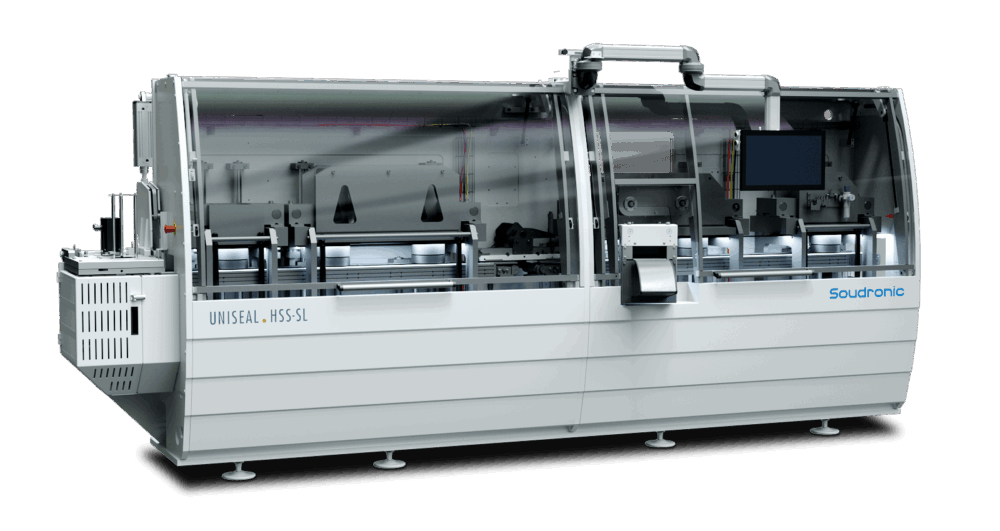
The Uniseal HSS-SL Single Lane model is aimed at customers entering the peel-off can market in relatively small quantities
Can Man’s X7 series medium and high-speed welders are fitted with its QuickChange system enabling an automated height change to be completed in two minutes and a complete can format change in 30 minutes. Other X7 series features include a QuickChange down-stacker.
Another of Soudronic’s recent launches is the PowerCoat oP machine which produces a seam coating the same colour as the main can body via the PowerCoat powder application system. This is an additional process that can be added to the X7 series and all three-piece can lines, Geide said.
“A lot of can manufacturer salespeople do not like welded seams showing on the side of welded cans, so we have developed a colour coating technique to ensure the finished welded can looks just like a two-piece can with a complete all-round can body coating,” Geide explained.
“We can do this on the can’s welded seam. It’s used mostly for lithograph-printed cans, so the welded seam colour and design matches the printed can body colour and design.”
To ensure the correct curing temperature at increased line speeds, the Can Man’s PowerCure preheater machine commonly is used to create a premium decorative finish. Geide explained: “This finish is mostly for cans with higher value contents, when it’s appropriate to give a higher value look to the welded seam.
“This includes higher value canned tomatoes in Italy, for example, or canned pineapple products and other foods. Paper labels can damage, so using printed cans ensures a better appearance.”
Meanwhile, Soudronic also supplies modern peel-off lid technologies to two and three-piece can makers to seal various retort and dry food products being filled in their cans.
The Uniseal HSS-SL Single Lane is a high-speed heat-sealing system for peel-off ends which is supplied fitted with one production lane. The model can be supplied with an optional ring-forming module to produce either composite or aluminium peel-off ends.
Designed for low to medium capacity production volumes, the single lane model includes many proven and newly added features of Soudronic’s multi-lane Uniseal HSS model which, with up to three lanes, has a 600 ends per minute output performance.
“Our Uniseal HSS-SL Single Lane model is aimed at customers entering the peel-off can market in relatively small quantities. It’s easy to change can sizes on this machine,” Geide said. “Retortable products being filled are mostly fishery products while the dry products include nuts, infant formula and milk powder. We also see some ghee products being filled in the Middle East.”
Three can sizes are commonly used for filling: the 127 diameter can size holds 800 grams; the 153 diameter size holds 1 to 1.2 kg; while the 189 diameter size holds from 1.5 to 2kg of chosen product.
By carefully targeting large, medium and small can makers with its recent machine launches, Geide feels confident that Soudronic’s new models will appeal to many customers looking to upgrade production quality and efficiency, while expanding their output capacity at the same time.
“We are looking forward to working with our customers around the globe on new projects,” Geide concluded, “whether these are single machines or turn-key complete new can-line projects.”
Topics
Aerosol can production automation market trends packaging aesthetics
PeopleOrganisationsCan Man European Union Soudronic AG
Regions