25 years of innovation
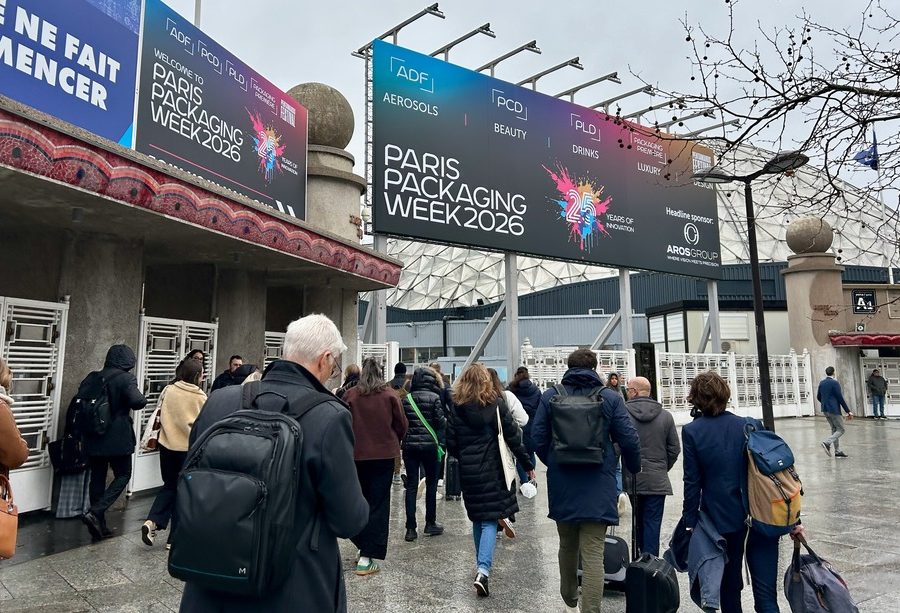
The 25th Edition of the show saw record-breaking attendance. Image: Alex R/Bell Publishing
On 5 and 6 February 2026, Hall 1 of Paris Expo Porte de Versailles welcomed a record-breaking 14,442 visitors for the 25th anniversary of Paris Packaging Week (PPW). This represented a 15 per cent increase compared with the previous edition, bringing together 20,462 participants, with 915 exhibitors, 213 speakers and professionals from 87 nationalities.
“This 25th anniversary edition marks a turning point. It reflects the maturity of the sector and the community’s ability to mobilise around practical, real-world challenges,” commented Noura Moussa, PPW’s marketing director.
What became clear during the event was that businesses are working harder than ever on R&D and innovation, all while keeping compliant as well as ahead of upcoming regulatory changes and sustainability targets. The hot topic of the two days across the conferences was the Packaging and Packaging Waste Regulation (PPWR), which was covered in presentations CanTech attended across the Aerosol and Dispensing Summit (ADF) from the FEA’s Alain D’Haese, Steel for Packaging Europe’s Steve Claus and PackIntelX’s Siddharth Bagri. The measures covered in the regulation will have significant impacts for producers and brands in terms of packaging design, material and coatings choice and cost structures. Fundamentally, metal should be at an advantage, but there is much preparation left to do.
Keeping the message simple
Many of the speakers across the two days, as well as the panellists, generally presented a positive future outlook. Alyne Freitas from the Brazilian Aerosol Association (ABAS) brought, as always, a fresh and uplifting presence to the stage. She discussed the leading aerosol products in Brazil – namely deodorants (70 per cent share), insecticides (67 per cent) and air fresheners (47 per cent) – and the high recycling rates, exploring the key drivers for Latin America into 2030.
The challenge, however, continues to be communicating the advantages of aerosols and metal packaging outside of the stakeholder chain and its experts. Many brands and associations are now launching educational consumer campaigns to properly convey information about the sustainability positives, the safety of aerosols and the recycling of them.
Alupro’s Tom Giddings discussed the encouraging initial results from the UK association’s “Spray, Squirt, Shake” campaign, which is aiming to simplify the language of aerosols and the meaning of an officially “empty” container to the public, with the goal of seeing more aerosol containers added to the aluminium recycling steam. The campaign results from Alupro’s work with Solihull saw a 16.9 per cent uplift in empty aerosols between samples after deploying the “Spray, Squirt, Shake” message, and a 9.2 per cent annualised uplift in metal collection (in tonnes). Alupro’s work with Bath & Northeast Somerset saw a 14 per cent increase in empty aerosols and a 4.9 per cent uplift in collections. Both trials have shown that the campaign is “an effective way of increasing public recycling confidence and improving metal aerosol recycling yields,” Giddings said.
The HCPA’s Nicholas Georges also explained a similar initiative in the US, partnering with Portland, Oregon Metro local governments to share its “Press It, Shake It, Recycle It” message.
Diving into more technical detail where material recovery facilities (MRFs) are concerned, managing director, Yaseed Chaumoo, explored his company’s packaging waste intelligence platform. Deepnest by Greyparrot is an AI solution that tracks how packaging actually performs in real world recycling systems – giving brands evidence based insights into recyclability, sorting behaviour and material recovery outcomes.
Chaumoo noted that while “There is a common trend to embrace ‘chaos packaging’ ie, complicated, complex-looking packaging,” this doesn’t always transfer successfully to MRFs during sorting, because it tends to confuse more traditional systems, meaning it could behave poorly in global waste steams. Chaumoo emphasised that often, “simplicity is key” when it comes to packaging design in this area.
Indeed, when it comes to luxury packaging – another huge highlight of Paris Packaging Week – metal “is increasingly concerned with a sophisticated and deliberate simplicity,” as Ball Corporation’s commercial vice president of aerosol packaging, Victoria Marletta, told CanTech International after PPW.
“This move toward minimalism is a conscious reaction against loud, cluttered branding. It signals confidence in both the product and the material itself,” she said.
“When busy graphics are removed, the focus shifts to the inherent quality of the package itself: its shape, the natural beauty of the metal and its satisfying weight. The tactile experience becomes paramount, with matte or soft touch finishes and subtle embossing replacing printed ink to convey craftsmanship. The simplicity feels curated and intentional. In this context, restraint becomes a design statement.”
She added: “However, ornate design is not obsolete. It remains highly effective for more targeted applications, such as vibrant limited editions or for heritage brands known for their opulent aesthetic. In general, however, while ornate designs have their place, the dominant trend is a confident minimalism that lets the quality of the metal itself communicate the brand’s premium status. Brands are increasingly choosing design language that reflects their positioning rather than following a single design aesthetic trend.”
Latest developments
Paris Packaging Week marked the first major European industry event since the integration of Sonoco’s metal and rigid paper packaging activities, bringing together the former Eviosys portfolio with Sonoco’s rigid paper packaging activities, under one unified business.
At its exhibition stand, Sonoco showcased its international range of aerosol cans, including G3, its latest innovation manufactured in the US. This two-piece steel aerosol can combines the advantages of steel with the appearance of what you can usually find in aluminium aerosol cans, the company explained. It features an integrated dome and no side seams, withstanding up to 15 bars of pressure.
Nussbaum has been producing aerosol cans made from used beverage cans (UBCs), the company’s sustainability manager, Aurelia Drenovac, told the ADF conference audience. NuCan AluGreen PCR represented a world-first in monobloc aluminium cans at the time of their release in 2021, with a CO2 reduction of 96 per cent. Now, the company is working on a new-to-the-industry UV technology, which is set to shorten the oven drying process and produce 65 per cent of energy savings across the entire manufacturing process, Drenovac said.
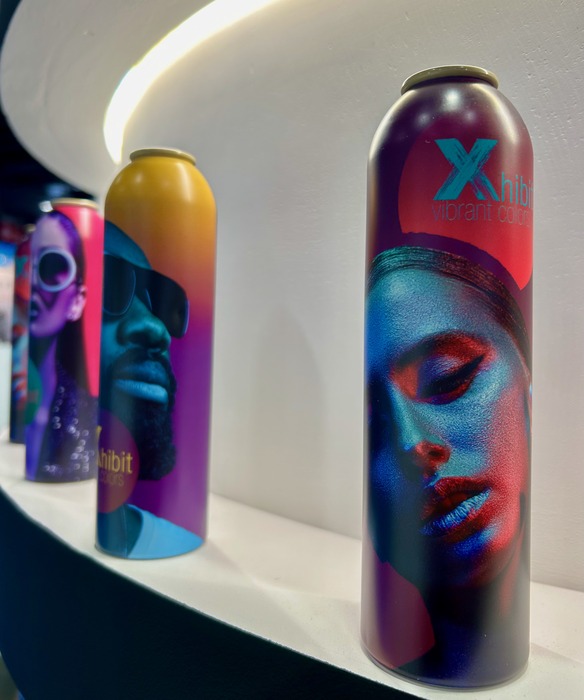
Hinterkopf’s digital printing product showcase. Image: Alex R/Bell Publishing
One topic that seems to be increasingly on customers’ minds is late determination – an issue that was frequently raised with Hinterkopf at PPW, the company’s communications and marketing manager, Nicole Blank, told CanTech International. Late determination enables brands to respond quickly to changing market conditions, address regional differences, incorporate seasonal trends and create customised artworks at short notice. “Digital direct-to-shape printing is the key to late determination. It dramatically reduces time-to-market, enabling brands to move from concept to shelf faster while combining packaging expertise with strong communication impact,” commented the company’s managing director, Alexander Hinterkopf.
Colourful opportunities
Towards the end of PPW, the ADF audience received a unique and lively discussion from professor Diana Derval at DervalResearch on how consumer perceptions of packaging design are often affected by their own individual innate, biological responses. For instance, the way the colours, red, green and purple enter the eyes are different. Derval did however, note that purple (the colour of her whole outfit on stage) is largely seen as an exciting yet calming blend of blue and red which signals luxury, creativity and premium quality.
Audience members were given a measuring device to work out their “hormonal quotient” which proved a highly entertaining task, comparing ourselves to well-known celebrities. The main takeaway from Derval was that it is crucial for brands to consider different consumer perceptions in this way, particularly before entering different markets with new products.
Discussing growth for metal packaging with CanTech, Ball’s Victoria Marletta said: “The biggest growth opportunities are where its unique properties – protection, premium feel and sustainability – can be most effectively leveraged. In categories where formulation performance and brand perception are critical, packaging plays an outsized role.
“Advanced skincare is a primary growth area. Educated consumers understand that aluminium’s opaque, airtight nature offers superior protection for sensitive active ingredients like Vitamin C and retinol. In haircare, metal is essential for the aerosol delivery of high-performance dry shampoos and styling foams. Furthermore, the ‘wellness’ and body care category is expanding, where beautifully designed aluminium packaging has significant shelf appeal, transforming everyday items, such as deodorants and lotions, into lifestyle designs. Here, packaging becomes part of the product experience itself. In personal and home care, packaging is no longer a passive container – it’s an active part of the product experience.”
She continued, highlighting that “Demographically, this growth is powered by Millennials and Gen Z. Their purchasing decisions are heavily influenced by a demand for sustainability, a story perfectly told by aluminium. For these consumers, packaging credibility directly affects brand credibility.
“Geographically, Europe is important due to strong regulations like the EU Green Deal, which is pushing brands away from single-use plastics, making aluminium a strategic necessity. North America is a fast-follower, where innovation is spurred by retailer standards and a thriving category of sustainable indie brands. Of course, there are similar long-term opportunities across Asia-Pacific, too. Taken together, these markets represent both immediate momentum and longterm structural growth,” she concluded.
Paris Packaging Week will return on 3 and 4 February 2027.
Topics
Packaging and Packaging Waste Regulation (PPWR)
PeopleAlain D'Haese Alexander Hinterkopf Alyne Freitas Aurelia Drenovac Diana Derval Nicholas Georges Nicole Blank Noura Moussa Tom Giddings Victoria Marletta Yaseed Chaumoo
OrganisationsAlupro ball corporation Brazilian Aerosol Association DervalResearch Hinterkopf Nussbaum Paris Packaging Week (PPW) sonoco
Regions