Global protectionist moves create can maker headaches

Durgapur Steel Plant, run by the Steel Authority of India Ltd (SAIL), in Durgapur, West Bengal. Image: Government of India
The increasing tendency towards global trade protectionism is restricting commerce in metals used by can makers worldwide, experts have told CanTech International. These measures are intensifying as “governments respond to global overcapacity, subsidy competition, geopolitical uncertainty and the need for stronger industrial resilience,” said Brussels-based metal packaging industry association, Metal Packaging Europe (MPE).
Krassimira Kazashka, MPE CEO, said tariffs, anti-dumping duties and other restrictions affecting steel and aluminium supplies increase the cost and complexity of sourcing metals for metal packaging manufacturing. “The sector relies on efficient and reliable supply chains, in which material quality, timing and supplier choice are critical,” she told CanTech.
Calling for a balanced approach that strengthens Europe’s metals base while safeguarding downstream industries that turn these materials into “permanent and recyclable packaging,” she said: “When trade barriers disrupt access to steel and aluminium, they reduce flexibility, create uncertainty and place additional pressure on manufacturers and fillers.”
United States can makers agree: “Tariffs on imported metals into the US that can manufacturers use to make cans means higher costs in the metal can value chain, often ultimately passed to consumers,” Pearce Crosland, senior director of federal government affairs at the Can Manufacturers Institute (CMI), told CanTech.
“There is not nearly enough tinplate steel and primary aluminium produced in the US to meet the needs of US can manufacturers, which directly employ more than 20,000 people,” the Washington-based US trade association director said.
Moreover: “The payoff in new domestic metal production has been minimal,” he made clear, with Trump tariffs resulting in only one tin mill restart in Gary, Indiana. “Even with that facility, US steel can manufacturers will still need to import more than two-thirds of the tinplate steel they need.”
Matt Meenan, vice president of external affairs at the Arlington, Virginia-based US Aluminum Association, told CanTech the US should implement strong scrap export controls, including a ban on exporting used beverage containers, with China “explicitly working to corner the global aluminium recycling market, just as it has with primary aluminium production in recent decades.”
Too much high-value scrap leaves the US instead of being recycled domestically, he said, making can makers and others more reliant on foreign imports: “About 85% of US aluminium production relies on recycled scrap and can sheet producers are especially dependent on high-quality material,” he explained.
The association noted that 26% of American aluminium scrap is shipped abroad, often ending up in China. And the US has a 1.3 million metric tonne trade deficit of aluminium scrap, “enough metal for 100 billion drinks cans, nearly the entire US can market.”
“Can sheet demand is also growing,” Meenan added, “and US industry has invested more than US$11 billion in plants and operations recently, including two new multi-billion-dollar aluminium rolling mills [in Bay Minette, Alabama, and Columbus, Mississippi] for the first time since 1980,” he said.
For Meenan, the goal of anti-dumping efforts, for example in Brazil’s duties on imports of aluminium sheet, is “to address unfairly traded imports or market distortions that can undermine local production and investment,” so “scrap matters more than ever.”
He concluded: “Strong trade enforcement is more about maintaining a level playing field, fair competition and a reliable domestic supply chain for manufacturers versus protectionism for its own sake.”
Brazil anti-dumping
Brazil is indeed a case in point, with its anti-dumping duties encouraging the development of can recycling – which is already well established. Latin America’s most populous country – with 213.6 million people – consumes 367,346 steel cans annually – with 49% of them recycled, according to Thais Fagury, executive president of the Brazilian Steel Packaging Association (Associação Brasileira de Embalagem de Aço – Abeaço) and recycling association Prolata Reciclagem.
Indeed, recycling might help the country’s can making and filling industry deal with protective levies that are significant in scale. In August 2025, Brazil’s Executive Management Committee of the Chamber of Foreign Trade (GECEX/Camex, the country’s core foreign trade policy association) announced a five-year definitive anti-dumping duty – provisional since October 2024 – on Chinese-origin alloy or non-alloy tin- or chromium-plated steel sheets and coils ranging from $284.34 to $499.35 per tonne.
Moreover, in January 2026, GECEX/Camex raised standard import tariffs on some steel products, including sheets for packaging, from 10.8% to 25% for a 12-month period.
“A second anti-dumping investigation is also underway, concerning imports of metal sheets originating from Germany, Japan and the Netherlands, with a decision expected by December,” said Fagury, adding that these countries are the main alternatives to Brazil’s key domestic producer of metal foil, CSN (Companhia Siderúrgica Nacional), for a Brazilian can making industry comprising more than 40 companies that makes billions of units annually.
That could load costs on a Brazilian food and beverage industry, which she said, “imports more than half of the metal sheet it consumes, due to technical requirements: thickness, tempering, coating, weldability, corrosion resistance and compatibility with food contact,” she told CanTech. She stressed that where steel with these qualities is not available in Brazil, manufacturers will be forced to pay for imported materials whose prices has been inflated by these trade restrictions.
Such problems can be worsened by crises, such as in 2020, during the onset of the Covid-19 pandemic, when CSN closed its key blast furnace supporting Brazilian production of metal packaging steel, recalled Fagury, disrupting the national supply, forcing up materials prices, causing the food industry to ask the government to temporarily reduce steel import taxes – which happened.
She recalled a similar situation in the US, when American steel producer Cleveland-Cliffs Inc and the United Steelworkers Union called for protection from cheaper imports in 2023. Although the US DoC subsequently determined that products from Canada, China, South Korea and Germany were being imported at less than fair value (and for
Chinese steel, unfairly subsidised by the Chinese government), a follow-up assessment by the USITC concluded in February 2023 that this dumping and subsidies had not actually injured the US steel industry, and therefore, tariffs were not applied.
“It was not the steel industry that reversed this decision. It was the can manufacturers and food companies, by demonstrating that local production did not supply the market,” said Fagury. Indeed, while arguing that proven dumping must be addressed, Fagury warned: “The tariff, alone, does not rebuild the producer.” In fact, she noted, 2018 import tariffs on steel imposed by the first Trump administration shrank US domestic production of steel sheet metal, because manufacturers were protected but not modernised.
Protection costs canned food consumers. In Brazil, said Fagury, since metal foil accounts for 15% to 25% of the production cost of canned food, according to the Brazilian Food Industry Association (Associação Brasileira da Indústria de Alimentos), protection is one reason why prices of canned food in Brazil increased 5.04% year-over-year in April 2026, while overall food prices increased 1.34% over the same period.
Middle East struggles
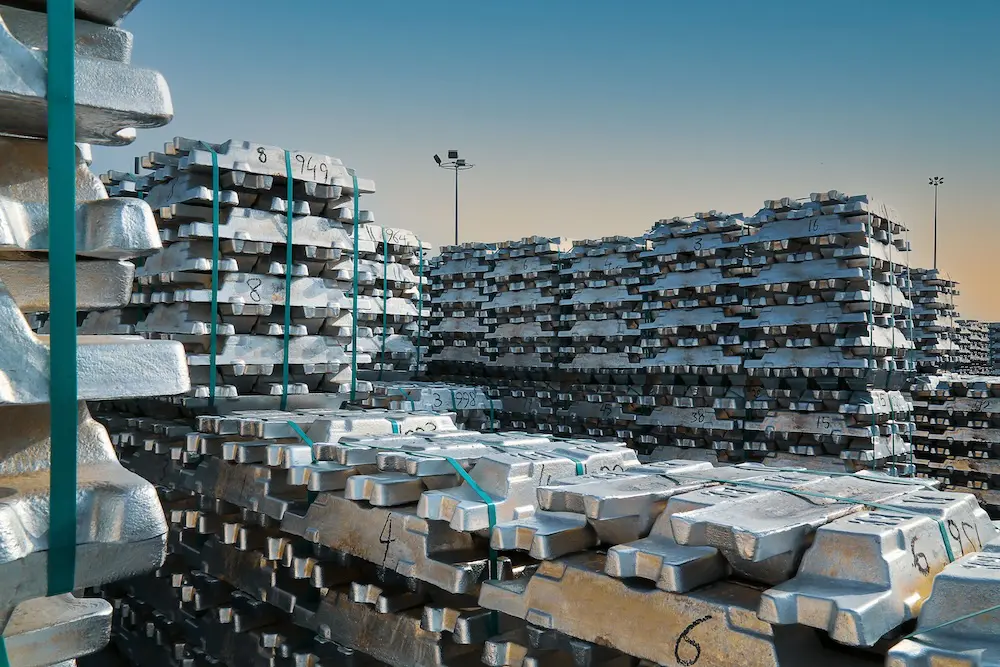
Ingots from Bahrain’s aluminium smelter Alba that feed the GARMCO rolling mill. Image: Alba-creativecommons.org/ licenses/by-sa/4.0/deed.en
Similar protectionist tussles are ongoing in the Middle East. Bahraini producer Gulf Aluminium Rolling Mill (GARMCO) has filed a lawsuit at the US Court of International Trade challenging the US department of commerce’s (DoC) administrative review of anti-dumping duties on common alloy aluminium sheet imported from the Gulf state. That continues anyway.
Indeed, on 13 July, the DoC issued a preliminarily review that determined that GARMCO “made sales of subject merchandise at less than normal value during the period of review of 1 April 2024, through to 31 March 2025,” at a weighted-average dumping margin of 6.25%. The review was initiated in May 2025 but was postponed due to the October/ November 2025 US federal government shutdown, with deadlines extended multiple times. Parties now have until 12 August to appeal. GARMCO did not respond to CanTech queries on this dispute.
It is a major producer of common alloy sheet and coil. The US imported 218,315 tonnes of aluminium from Bahrain in 2025, and 59,600 tonnes in January to May 2026, according to US DoC. For 2021-2024, Bahrain accounted for 4% of US imports of aluminium, according to the 2026 US Geological Survey; and 11% of imported aluminium alloys, according to Aluminium Market Update.
Aluminium production has been badly hit in Bahrain by the US and Israeli-led war on Iran since 28 February. In March, Aluminium Bahrain (Alba), which produced 1.6 million tonnes in 2025, sustained damage to its smelter facilities when they were hit by Iranian missiles. Earlier in the month, Alba had shut down 19% of its production capacity due to the closure of the Strait of Hormuz.
Paul Adkins, founder and managing director of Hong Kong-based aluminium consultancy AZ Global, told CanTech: “Alba shut three potlines, and there have been rumours of further cuts to output. Even if those rumours are untrue, their logistics systems remain difficult. Shipments of metal to customers must take circuitous routes, and the ability to receive raw materials is also constrained. The resumption of hostilities is only making it more difficult for Alba and the other smelters in the area,” he said.
India pressures
Given the importance of the American economy worldwide, the impact of its protectionist measures ripple even further into Asia. India is a case in point. Such evolving trade dynamics are not isolated disputes but a systemic shift in the global macro-economic landscape, according to Rajamani Krishnamurti, president of Indian Stainless Steel Development Association in New Delhi. “Post Covid-19 pandemic geo-political realities have forced the nations to classify metals, particularly the stainless steel, as critical infrastructure materials,” and hence a priority for protection of domestic producers, he told CanTech. “So, governments are actively using trade barriers to shield domestic industry from global market volatilities.”
As well as the general 18% duties imposed on Indian steel and aluminium exports to the US, the American government has also sought to restrict trade with India using anti-dumping and countervailing (anti-subsidy) duties, which have, for example, restricted its trade in steel with the US. That includes countervailing duties on cut-to-length carbon-quality steel plate, which are used to make industrial cans and drums. Faced with such pressures, Indian steel companies have engaged with US commerce department administrative reviews via rigorous data-driven, legal and economic methodologies, said Krishnamurti.
However, they never succeed and sometimes even face duty increases following reviews, said Krishnamurti. Stressing that India’s steel industry is not state-owned – although it does receive some state support, notably via the national steel ministry, he said a 118% surge in Indian steel exports to the US in 2025 was demand-driven.
These duties distort the markets as according to Krinshamurti, when premium cost-efficient steel suppliers like India are marginalised and domestic US mills get unchecked pricing power, it can be inflationary: “Historically this lack of foreign competition allows domestic prices to artificially swell by 15 to 30 per cent above global averages.”
China crisis
The problem fuelling much of this protection-ism, however, remains, and that is the dominance of Chinese steel and aluminium exports in global markets. China’s state-backed industrial sector pro-duced 60% of the world’s aluminium in 2024, noted Canadian government figures, and the OECD Steel Committee has consistently warned about Chinese steel trade flows. Following its March 2026 meeting, committee chair, Sheryl Groeneweg, said: “China’s share of global excess capacity rose during 2025, surpassing 50% in the latter part of the year, spur-ring surges of exports to international markets.
This excess capacity is putting enormous pressure on international markets by displacing production, driving prices and industry profitability down.” Non-OECD countries are trying to maintain their steel sales against Chinese competition by “flood-ing foreign markets with steel and contributing to significant employment losses,” said Groeneweg.
In June, the OECD warned in a report that these problems were continuing, projecting global steel excess capacity to reach 745 million tonnes by 2028, exceeding OECD member countries’ current steel production by 319 million tonnes. Planned capacity additions of up to 139 million tonnes through 2028 represent a 5.7% increase from 2025 levels, while demand growth is expected to remain subdued at around 0.9% per year.
It added: “Most new capacity is being added outside the OECD, often with government support. In 2024, the median Chinese steel firm received 15 times more in subsidies, relative to their total assets, than producers elsewhere, up from 10 times in 2023. Chinese steelmakers exported a record 131 million tonnes in 2025, a 153% increase from 2020 and more than the European Union’s total steel production in 2025.”
TopicsPeople
Krassimira Kazashka Matt Meenan Paul Adkins Pearce Crosland Rajamani Krishnamurti Sheryl Groeneweg Thais Fagury
OrganisationsAlba Aluminum Association AZ Global Brazilian Food Industry Association (Associação Brasileira da Indústria de Alimentos) Brazilian Steel Packaging Association (ABEAÇO) Can Manufacturers Institute (CMI) CSN (Companhia Siderúrgica Nacional) GARMCO GECEX/Camex Indian Stainless Steel Development Association Metal Packaging Europe (MPE) OECD Steel Committee
Regions